
This article has been updated for the MUTCD 11th Edition, published December 2023 by the FHWA. The 11th Edition supersedes the 2009 MUTCD and updates requirements for retroreflective treatments at highway-rail grade crossings. States must adopt the 11th Edition by January 18, 2026.
MUTCD Crossbuck Retroreflective Strip Requirements
The Manual on Uniform Traffic Control Devices (MUTCD) establishes specific requirements for retroreflective materials on highway-rail grade crossing (crossbuck) signs and their supports. These retroreflective strips are critical for nighttime visibility at railroad crossings, helping drivers identify the presence of crossbuck signs and their mounting posts in darkness. The 11th Edition of the MUTCD, published in December 2023, continues these important safety requirements.
What Changed from the 2009 Edition
Previously under the 2009 Edition (and carried forward from the 2000 Edition), the compliance date for retroreflective strips on grade crossing crossbuck signs (R15-1) and Number of Tracks plaques (R15-2P) at active and passive grade crossings was January 17, 2011. This deadline has long since passed, and these retroreflective strip requirements are now fully established standards.
The 11th Edition continues to require retroreflective treatment of crossbuck signs and supports. Additionally, the 11th Edition includes updated provisions for crossbuck assemblies, including the requirement (originally introduced in the 2009 MUTCD with a December 31, 2019 compliance date) that STOP or YIELD signs be used with crossbuck signs at passive grade crossings. This provision is also now a current standard under the 11th Edition.
Retroreflective Strip Standards
The MUTCD specifies the following retroreflective requirements for crossbuck signs and their supports:
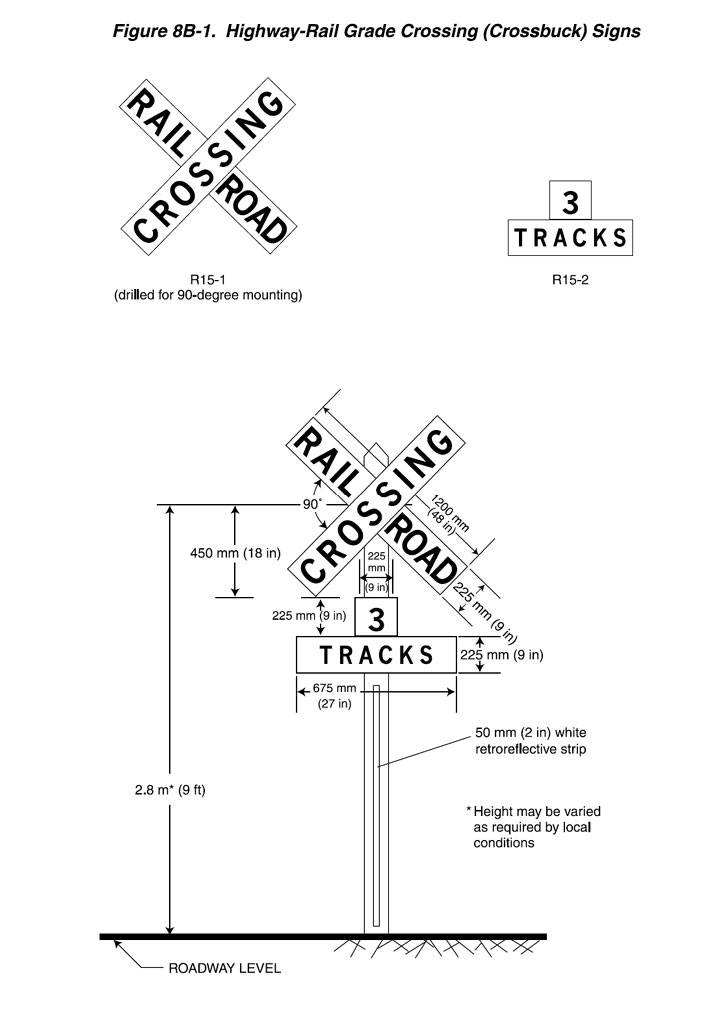
Standard: The Highway-Rail Grade Crossing (R15-1) sign, commonly identified as the Crossbuck sign, shall be retroreflectorized white with the words RAILROAD CROSSING in black lettering.
As a minimum, one Crossbuck sign shall be used on each highway approach to every highway-rail grade crossing, alone or in combination with other traffic control devices.
If automatic gates are not present and if there are two or more tracks at the highway-rail grade crossing, the number of tracks shall be indicated on a supplemental Number of Tracks (R15-2) sign of inverted T shape mounted below the Crossbuck sign.
Retroreflective Strip Specifications
Standard: A strip of retroreflective white material not less than 50 mm (2 inches) in width shall be used on the back of each blade of each Crossbuck sign for the full length of each blade. A strip of retroreflective white material, not less than 50 mm (2 inches) in width, shall be used on each support at highway-rail grade crossings for the full length of the front and back of the support from the Crossbuck sign or Number of Tracks sign to near ground level.
These retroreflective strips serve a vital safety function by making the crossbuck assembly visible to approaching motorists during nighttime conditions. The 2-inch minimum width ensures adequate visibility at the distances needed for safe stopping.
Crossbuck Sign Placement
Standard: The Crossbuck sign shall be installed on the right side of the highway on each approach to the highway-rail grade crossing. Where restricted sight distance or unfavorable highway geometry exists on an approach, an additional Crossbuck sign shall be installed on the left side of the highway.
Guidance: Crossbuck signs should be located with respect to the highway pavement or shoulder in accordance with the criteria in Chapter 2A. The lateral clearance for the nearest edge of the Crossbuck sign should be 1.8 m (6 ft) from the edge of the shoulder, or 3.7 m (12 ft) from the edge of the traveled way in rural areas, and 0.6 m (2 ft) from the face of the curb in urban areas.
Where unusual conditions make variations in location and lateral clearance appropriate, engineering judgment should be used to provide the best practical combination of view and safety clearances.
STOP or YIELD Signs at Passive Grade Crossings
The 11th Edition incorporates the requirement that STOP or YIELD signs be installed at passive grade crossings in conjunction with crossbuck signs. This provision, originally introduced in the 2009 MUTCD (Section 8B.04) with a compliance date of December 31, 2019, is now a current standard. Agencies that have not yet installed STOP or YIELD signs at passive crossings should prioritize this work.
11th Edition Compliance Timeline
All previous compliance dates for crossbuck retroreflective strips under the 2009 MUTCD have passed. Under the 11th Edition, states and local agencies must adopt the new manual by January 18, 2026. Agencies should verify that all crossbuck assemblies in their jurisdiction have proper retroreflective strips on both the sign blades and the support posts, and that passive crossings include the required STOP or YIELD signs.