This article has been updated for the MUTCD 11th Edition, published December 2023 by the FHWA. The 11th Edition supersedes the 2009 MUTCD and continues the lateral offset and clear zone requirements for traffic sign supports. States must adopt the 11th Edition by January 18, 2026.
MUTCD Lateral Offset Requirements for Traffic Signs
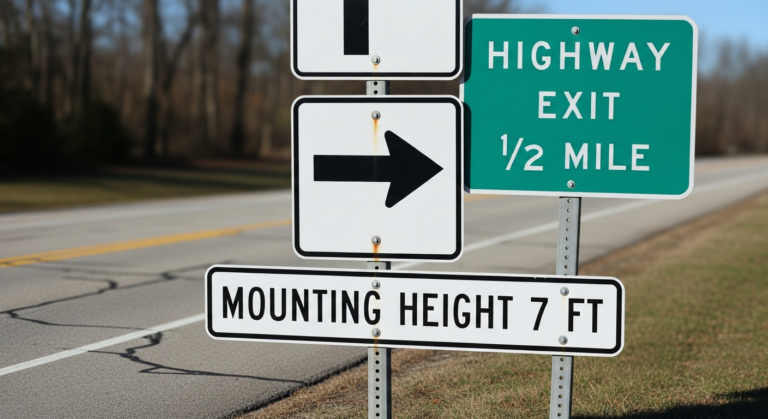
The Manual on Uniform Traffic Control Devices (MUTCD) establishes specific requirements for the lateral placement of traffic signs relative to the roadway. Proper lateral offset ensures that signs are visible to drivers while keeping sign supports safely outside the traveled way. The 11th Edition of the MUTCD, published in December 2023, continues and refines these lateral offset standards.
What Changed from the 2009 Edition
Previously under the 2009 Edition, the key compliance date for lateral offset requirements was January 17, 2013, which required crashworthiness of sign supports on roads with posted speed limits of 50 mph or higher. This compliance date has passed, and the crashworthiness requirement is now a current mandatory standard.
The 11th Edition carries forward the lateral offset standards from Section 2A.19 of the 2009 MUTCD. The fundamental requirements for minimum lateral offsets from the edge of the traveled way and shoulder remain substantively the same. The 11th Edition continues to emphasize crashworthy (breakaway, yielding, or shielded) sign supports within the clear zone, and provides refined guidance on balancing sign visibility with safety clearances.
Section 2A.19 — Lateral Offset Standards
Overhead Sign Supports
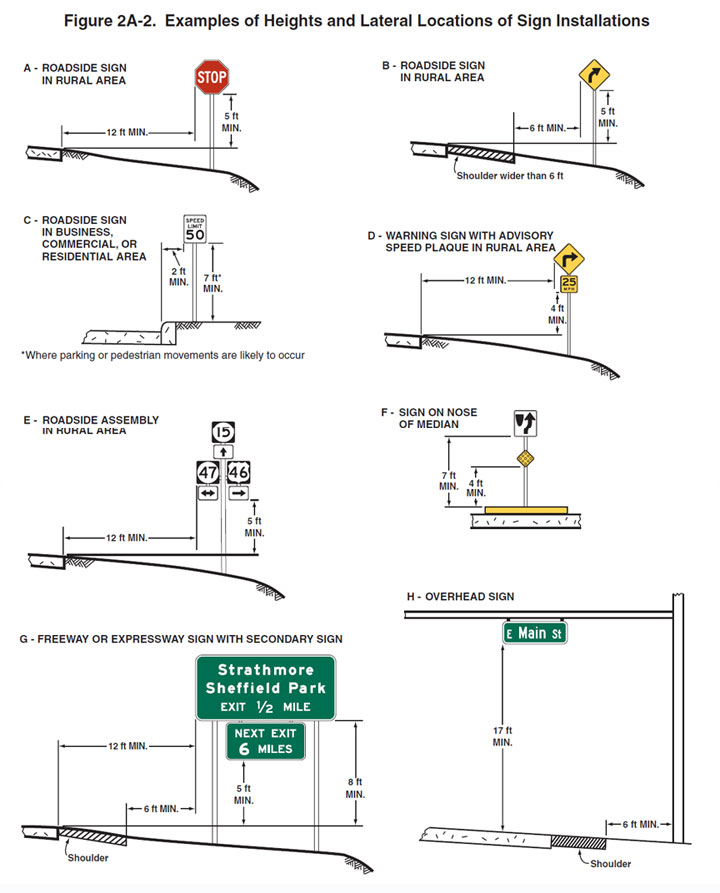
Standard: For overhead sign supports, the minimum lateral offset from the edge of the shoulder (or if no shoulder exists, from the edge of the pavement) to the near edge of overhead sign supports (cantilever or sign bridges) shall be 6 feet. Overhead sign supports shall have a barrier or crash cushion to shield them if they are within the clear zone.
Post-Mounted Sign Supports
Standard: Post-mounted sign and object marker supports shall be crashworthy (breakaway, yielding, or shielded with a longitudinal barrier or crash cushion) if within the clear zone.
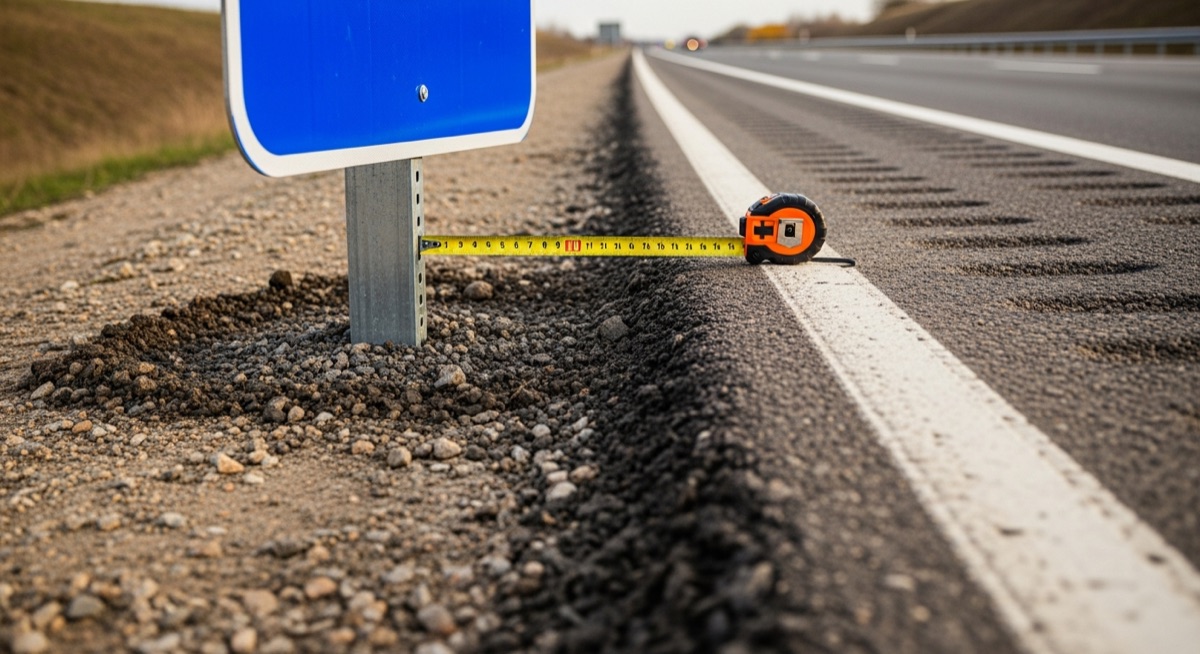
Guidance: For post-mounted signs, the minimum lateral offset should be 12 feet from the edge of the traveled way. If a shoulder wider than 6 feet exists, the minimum lateral offset for post-mounted signs should be 6 feet from the edge of the shoulder.
Support: The minimum lateral offset is intended to keep trucks and cars that use the shoulders from striking the signs or supports.
Placement Best Practices
Guidance: All supports should be located as far as practical from the edge of the shoulder. Advantage should be taken to place signs behind existing roadside barriers, on over-crossing structures, or other locations that minimize the exposure of the traffic to sign supports.
Option: Where permitted, signs may be placed on existing supports used for other purposes, such as highway traffic signal supports, highway lighting supports, and utility poles.
Standard: If signs are placed on existing supports, they shall meet other placement criteria contained in this Manual.
Reduced Lateral Offsets
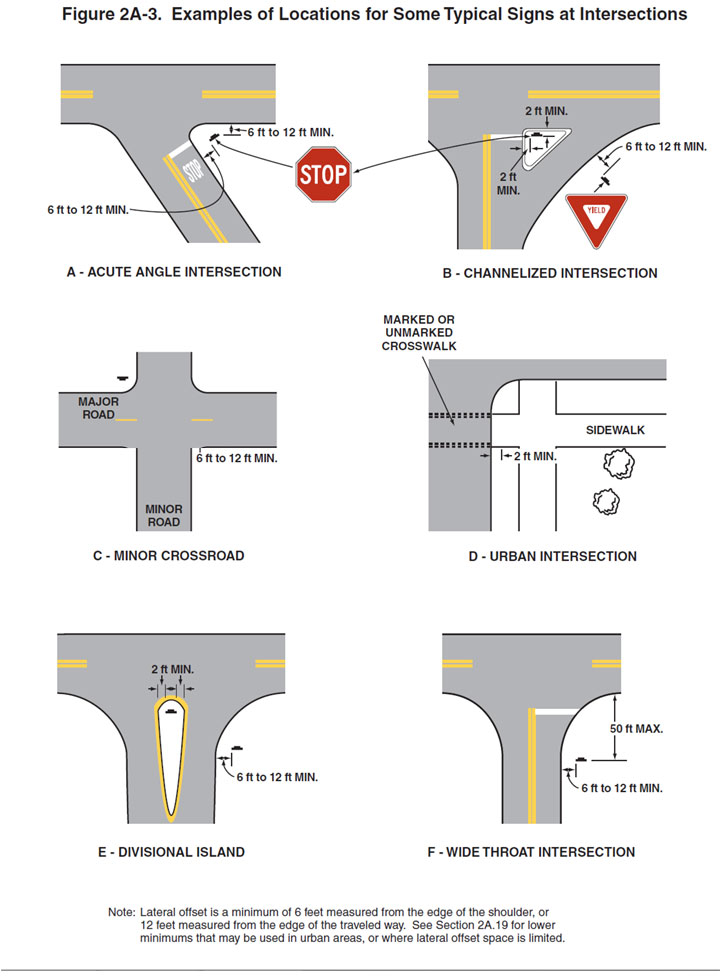
Option: Lesser lateral offsets may be used on connecting roadways or ramps at interchanges, but not less than 6 feet from the edge of the traveled way.
On conventional roads in areas where it is impractical to locate a sign with the prescribed lateral offset, a lateral offset of at least 2 feet may be used. A lateral offset of at least 1 foot from the face of the curb may be used in business, commercial, or residential areas where sidewalk width is limited or where existing poles are close to the curb.
Guidance: Overhead sign supports and post-mounted sign and object marker supports should not intrude into the usable width of a sidewalk or other pedestrian facility.
Lateral Offset Illustrations
The following figures from the MUTCD illustrate the lateral offset requirements for various roadway configurations.
11th Edition Compliance Timeline
The January 17, 2013 compliance date for crashworthy sign supports under the 2009 MUTCD has passed. This is now a current mandatory standard. Under the 11th Edition, states and local agencies must adopt the new manual by January 18, 2026. Agencies should review their sign support inventory, particularly on high-speed roads (50 mph or higher), to verify that all supports within the clear zone are crashworthy — breakaway, yielding, or shielded with appropriate barriers.