MUTCD Part 6: Temporary Traffic Control — Complete Reference Guide
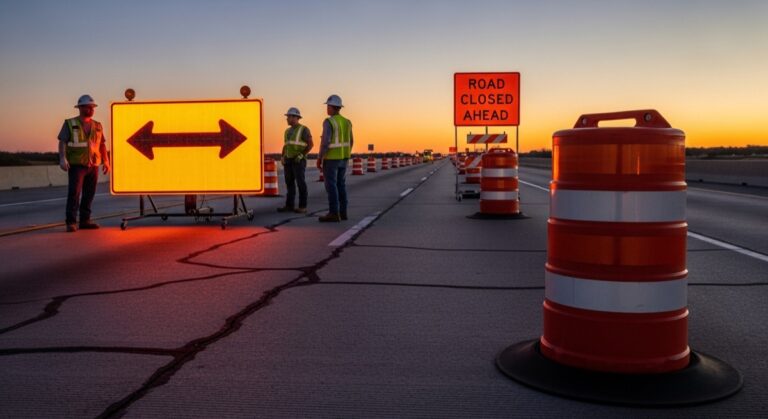
Part 6 of the MUTCD covers Temporary Traffic Control (TTC), commonly known as work zone traffic control. This Part establishes the standards for managing traffic through, around, and past work zones, incident scenes, and other temporary conditions on roadways. Part 6 is essential for highway contractors, utility companies, maintenance crews, and traffic engineers responsible for worker and road user safety during construction and maintenance operations.
What Part 6 Covers
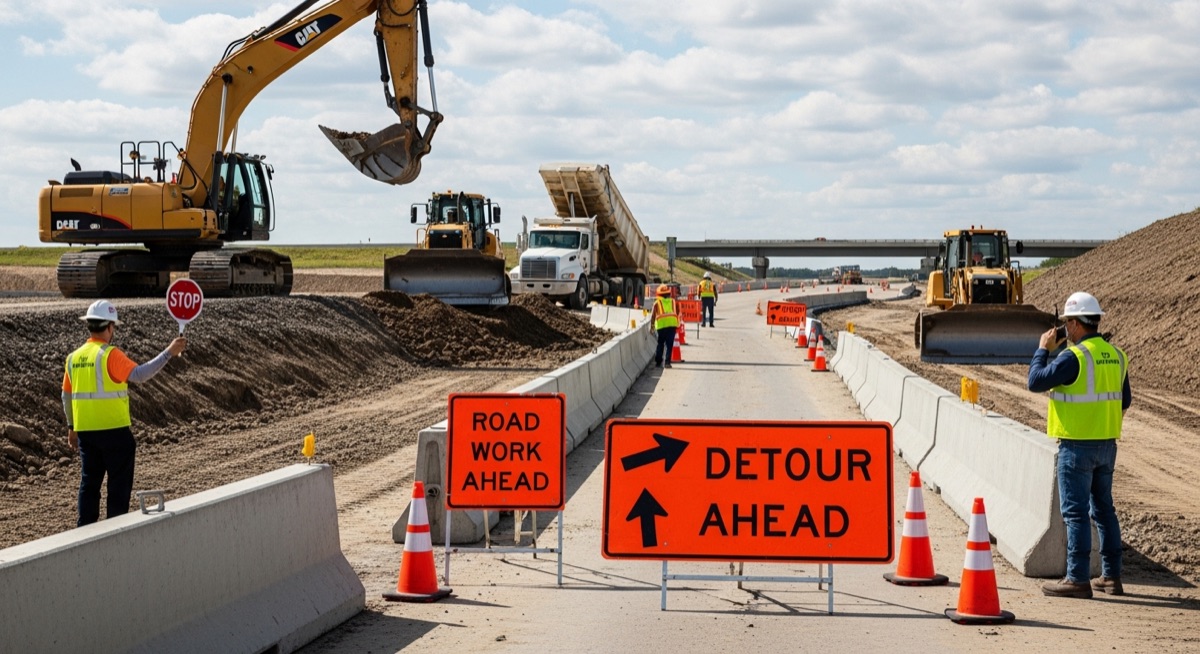
Part 6 — Temporary Traffic Control — provides comprehensive standards for the planning, design, implementation, and removal of traffic control devices in work zones and temporary conditions. It covers the principles of TTC zone design, the specific devices used (signs, channelizing devices, barriers, arrow panels, flaggers), typical application diagrams for common work zone scenarios, and special provisions for various road types including freeways, urban streets, and low-volume roads.
Key Chapters in Part 6
- Chapter 6A — General: Establishes the fundamental principles of temporary traffic control, including the six parts of a TTC zone (advance warning area, transition area, buffer space, activity area, termination area, and the work space itself). Defines the responsibilities of the agency and contractor.
- Chapter 6B — Fundamental Principles of Temporary Traffic Control: Covers TTC plan requirements, the role of the Responsible Person (RP), training requirements for TTC personnel, and the hierarchy of road user needs through work zones.
- Chapter 6C — Temporary Traffic Control Elements: Detailed standards for all TTC devices including signs (orange background), channelizing devices (cones, drums, barricades, vertical panels), temporary markings, arrow panels, portable changeable message signs, temporary traffic barriers, and temporary signals.
- Chapter 6D — Pedestrian and Worker Safety: Standards for pedestrian access through work zones, worker safety provisions, temporary pedestrian facilities, ADA-compliant work zone walkways, and work zone speed management.
- Chapter 6E — Flagger Control: Comprehensive standards for flagging operations, including flagger positioning, equipment (STOP/SLOW paddle, high-visibility apparel), signaling procedures, and one-lane, two-way traffic control.
- Chapter 6F — Temporary Traffic Control Zone Devices: Specifications for temporary signs, channelizing devices, lighting, and other TTC zone devices, including retroreflectivity and dimensional requirements.
- Chapter 6G — Type of Temporary Traffic Control Zone Activities: Standards organized by type of work: utility operations, mobile operations, short-duration operations, intermediate-duration operations, long-duration operations, and work adjacent to the roadway.
- Chapter 6H — Typical Applications: The critical chapter containing numbered Typical Application (TA) diagrams that illustrate standard TTC setups for dozens of common work zone scenarios. These TAs are the foundation of most TTC plans.
- Chapter 6I — Control of Traffic Through Traffic Incidents: Standards for traffic control at incident scenes, including emergency vehicle operations and law enforcement-directed traffic control.
Critical Standards (SHALL Requirements)
- Section 6A.01 — TTC Plan: A TTC plan SHALL be developed for all work zones on roadways open to public travel. The level of detail in the plan SHALL be appropriate for the complexity of the work zone.
- Section 6C.02 — Work Zone Sign Design: Temporary traffic control signs SHALL have a black legend and border on an orange background. Sign sizes SHALL meet the minimum dimensions for the applicable road type.
- Section 6C.04 — Channelizing Devices: Channelizing devices SHALL be retroreflective or equipped with retroreflective material for nighttime use. They SHALL be a minimum of 28 inches (700 mm) in height on high-speed roads (45 mph or higher) and 18 inches (450 mm) on lower-speed roads.
- Section 6D.03 — Worker High-Visibility Apparel: All workers within the right-of-way who are exposed to traffic or construction equipment SHALL wear high-visibility safety apparel meeting the Performance Class 2 or 3 requirements of ANSI/ISEA 107.
- Section 6E.01 — Flagger Qualifications: Flaggers SHALL be trained in safe traffic control practices. Flaggers SHALL use a STOP/SLOW paddle as the primary hand-signaling device. The paddle SHALL be at least 18 inches (450 mm) in diameter/width.
- Section 6E.02 — Flagger Apparel: Flaggers SHALL wear high-visibility safety apparel meeting ANSI/ISEA 107 Performance Class 2 or 3.
- Section 6F.01 — Advance Warning Signs: Advance warning signs SHALL be placed in advance of the TTC zone. The number of advance warning signs and their spacing SHALL be based on the road type and speed.
- Section 6G.02 — Duration-Based Requirements: The level of TTC devices SHALL be based on the duration and nature of the work. Long-duration stationary operations require the highest level of TTC.
Key Guidance (SHOULD Items)
- TTC plans SHOULD be designed to route road users through work zones at speeds compatible with the conditions.
- Work zone speed limits SHOULD be based on engineering judgment considering worker exposure, lane widths, sight distance, and traffic volumes.
- Pedestrian access through work zones SHOULD be maintained at all times where pedestrian routes exist. If not feasible, a signed detour route SHOULD be provided.
- Arrow panels SHOULD be used for lane closures on multi-lane roads with speed limits of 45 mph or higher.
- Temporary raised pavement markers SHOULD supplement temporary pavement markings in long-duration work zones on high-speed roads.
TTC Zone Components
| Zone Component | Purpose | Key Requirements |
|---|---|---|
| Advance Warning Area | Alerts road users of upcoming work zone | Advance warning signs (W20-1 “Road Work Ahead,” etc.) spaced per Table 6C-1 |
| Transition Area | Moves traffic out of its normal path | Taper length = speed (mph) x distance (feet) per taper formula; channelizing devices at prescribed spacing |
| Buffer Space | Provides a safety margin between traffic and activity | Longitudinal buffer length based on speed; lateral buffer as wide as practical |
| Activity Area | Where the work actually occurs | Contains work space, traffic space, and sometimes a buffer between them |
| Termination Area | Returns traffic to normal conditions | Downstream taper and END ROAD WORK sign |
Advance Warning Sign Spacing (Table 6C-1)
| Road Type | Speed | Sign Spacing (A, B, C distances) |
|---|---|---|
| Urban (low speed) | 25-35 mph | A = 100 ft, B = 100 ft, C = varies |
| Urban (high speed) | 40-55 mph | A = 350 ft, B = 350 ft, C = varies |
| Rural | 45-55 mph | A = 500 ft, B = 500 ft, C = varies |
| Freeway / Expressway | 55+ mph | A = 1,000 ft, B = 1,500 ft, C = 2,640 ft (0.5 mi) |
Note: These are representative values. Consult Table 6C-1 in the full MUTCD for complete spacing requirements.
Compliance Dates
All new work zones established after the effective date of the 11th Edition (January 18, 2024) SHALL comply with the 11th Edition standards. This includes TTC plan development, device selection, flagger training, and typical application compliance. Agencies should ensure their TTC plan templates and standard specifications are updated to reflect 11th Edition requirements.
What Changed in the 11th Edition
- Pedestrian access emphasis: Significantly strengthened requirements for maintaining pedestrian and bicycle access through work zones, including ADA-compliant temporary pedestrian paths.
- Worker safety provisions: Updated high-visibility apparel standards and worker safety best practices.
- Typical Applications updated: Several Typical Application diagrams were revised or added to address modern work zone scenarios, including roundabout work zones and bicycle facility work zones.
- Low-volume road content integrated: Work zone provisions formerly in Part 5 (Low-Volume Roads) of the 2009 Edition are now incorporated into Part 6 with appropriate modifications.
- Positive protection guidance: Enhanced guidance on the use of temporary traffic barriers, truck-mounted attenuators, and other positive protection devices in high-speed work zones.
- Speed management: Updated provisions for work zone speed management, including the use of temporary speed feedback signs and enforcement.
- Incident management: Updated Chapter 6I to reflect modern incident management practices and coordination with emergency responders.
Related Resources on mutcd.info
- Part 1: General Provisions — Reference Guide
- Part 2: Signs — Complete Reference Guide
- Work Zone Signs: Orange Sign Standards
- Flagger Requirements and Training Standards
- Work Zone Typical Applications Guide
For the complete text of Part 6, visit the official FHWA MUTCD at mutcd.fhwa.dot.gov. The Part 6 PDF is available at mutcd.fhwa.dot.gov/pdfs/11th_Edition/part6.pdf.