
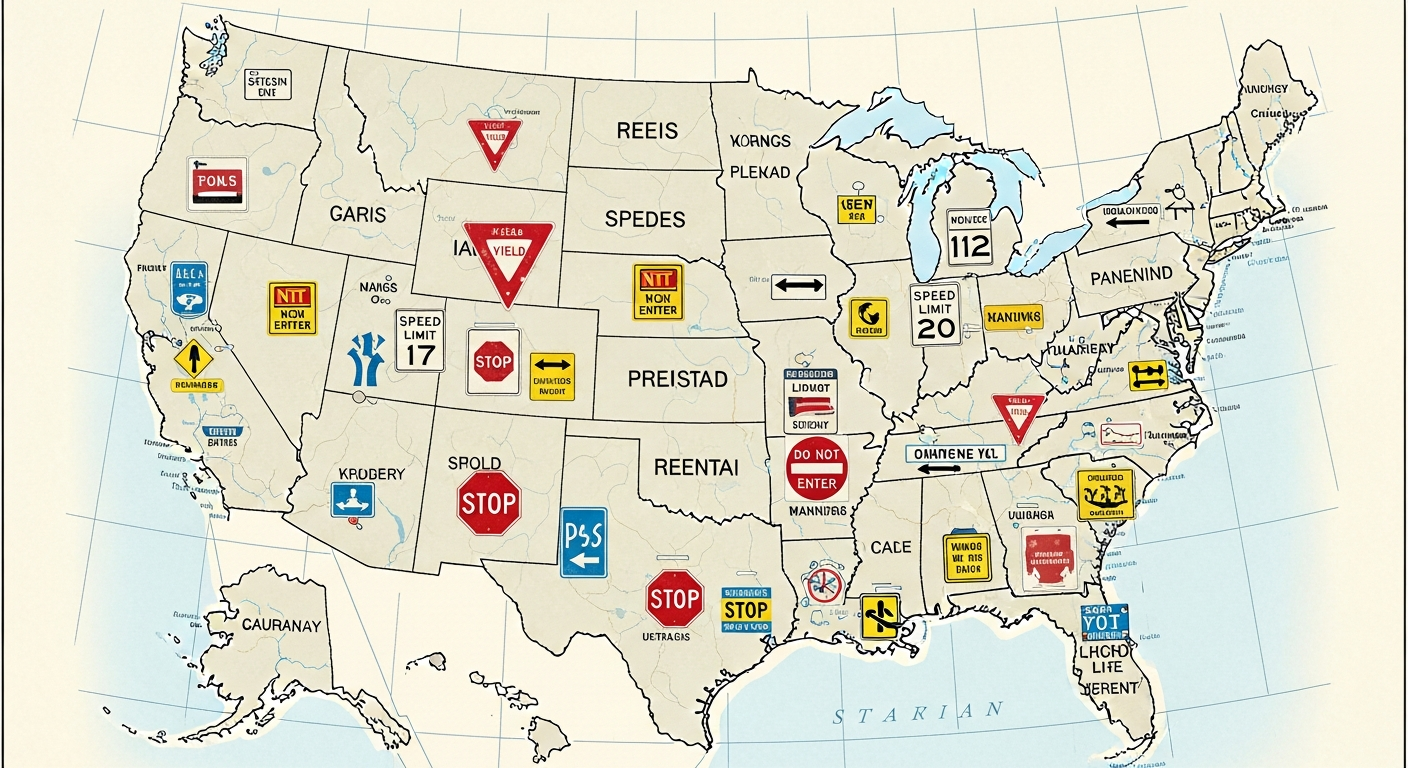
The federal Manual on Uniform Traffic Control Devices (MUTCD) sets the national baseline for traffic signs, signals, and pavement markings — but individual states are not always required to follow it verbatim. Most states adopt the federal MUTCD through a state supplement or a state-specific manual that may add, modify, or clarify provisions. Understanding how your state’s supplement differs from the federal MUTCD is essential for engineers, contractors, and agencies involved in traffic control.
What Is a State MUTCD Supplement?
A state MUTCD supplement is an official document issued by a state’s department of transportation (DOT) that modifies or extends the federal MUTCD for use within that state. Under 23 CFR 655.603, states must adopt the National MUTCD as a minimum standard for roads that receive federal funding, but they are permitted to supplement it with additional requirements. A supplement cannot reduce the federal MUTCD’s standards — it can only add to them or provide state-specific guidance. For a foundation in how the MUTCD is structured, see our introduction to the MUTCD.
Three Approaches to State Adoption
States generally follow one of three approaches when adopting the federal MUTCD:
1. Adopt the Federal MUTCD As-Is
Some states adopt the federal MUTCD in its entirety without any modifications. These states simply reference the federal document as their official standard. This approach is the simplest and ensures complete consistency with the national standard. States using this method include several smaller states with limited resources for developing their own supplement.
2. Adopt the Federal MUTCD with a State Supplement
This is the most common approach. The state adopts the federal MUTCD as its base document and publishes a separate supplement that contains state-specific additions, modifications, and clarifications. The supplement is organized to correspond to the same part and section numbering as the federal MUTCD, making cross-referencing straightforward. States like Texas, California, Florida, and New York use this model.
3. Publish a State-Specific MUTCD
A few states publish their own complete manual that is based on — but distinct from — the federal MUTCD. These state manuals incorporate federal requirements while reorganizing content and adding extensive state-specific provisions. California is a notable example, with the California MUTCD (CA MUTCD) serving as a standalone document that integrates federal and state requirements into a single reference.
Common Areas Where States Differ
While the federal MUTCD provides a consistent national framework, state supplements frequently address the following areas differently:
- Sign sizes: Some states require larger sign sizes than the federal minimums, particularly for speed limit signs and warning signs on higher-speed roads.
- School zone provisions: States often have unique school zone signing and speed limit requirements that go beyond MUTCD Part 7. Flashing beacon timing, school zone hours, and supplemental plaques vary significantly by state.
- Pavement marking colors and widths: While the MUTCD standardizes yellow and white line usage, some states specify wider markings, additional edge line requirements, or different retroreflectivity thresholds.
- Work zone requirements: State supplements commonly add requirements for work zone speed reductions, law enforcement presence, and specific temporary traffic control device specifications. See our work zone traffic control guide for the federal baseline.
- Speed limit sign placement: States may specify additional speed limit sign spacing intervals or require confirmation signs after every intersection.
- Unique state-specific signs: Some states authorize signs not found in the federal MUTCD, such as state-specific wildlife crossing signs, agricultural vehicle warnings, or unique regulatory messages.
- Retroreflectivity maintenance: While the federal MUTCD sets minimum retroreflectivity levels, states may establish more aggressive replacement schedules or different assessment methods. Our retroreflectivity requirements guide covers the federal standards.
The 11th Edition Adoption Deadline
The FHWA published the 11th Edition of the MUTCD on December 19, 2023, with an effective date of January 18, 2024. States have two years from the effective date — until January 18, 2026 — to adopt the new edition and update their state supplements accordingly. This means that by early 2026, all states must either adopt the 11th Edition as-is or publish updated supplements that incorporate the 11th Edition changes.
This transition period creates a critical window for state DOTs. The 11th Edition includes significant changes — including new provisions for automated vehicles, updated pedestrian crossing treatments, and revised sign retroreflectivity requirements — that state supplements must address. For a complete summary of what changed, see our 11th Edition key changes article. The detailed compliance dates timeline outlines specific deadlines for individual provisions.
How to Find Your State’s Supplement
Finding your state’s MUTCD supplement is straightforward:
- FHWA State MUTCD Page: The Federal Highway Administration maintains a page listing each state’s MUTCD adoption status and links to state supplements at mutcd.fhwa.dot.gov/resources/state_info/.
- State DOT website: Search your state DOT’s website for “MUTCD,” “traffic control devices manual,” or “state supplement.” Most state DOTs publish the supplement as a downloadable PDF.
- Contact your state traffic engineer: Each state DOT has a state traffic engineer’s office responsible for the MUTCD and state supplement. They can provide the current document and answer questions about state-specific requirements.
Why State Supplements Matter
For practitioners working across state lines, understanding state supplements is not optional — it is a professional responsibility. A traffic control plan that meets the federal MUTCD may not satisfy state requirements, and non-compliance can create liability exposure and safety issues. Contractors, consultants, and local agencies should always verify that their designs meet both the federal MUTCD and the applicable state supplement. When the standards conflict, the more restrictive requirement generally governs on federal-aid highways.
State supplements exist to address legitimate local conditions — climate, terrain, driver populations, and legislative mandates — that the federal MUTCD cannot anticipate for all 50 states. They are a feature of the system, not a flaw, and staying current with your state’s supplement is essential for delivering safe, compliant traffic control.