MUTCD School Zone Sign Requirements
School zones demand some of the most specific signage requirements in the entire MUTCD. Part 7 (Traffic Control for School Areas) establishes standards for signs, markings, and other traffic control devices used to protect children traveling to and from school. This guide covers the key requirements every traffic engineer and school district needs to know.
The Fluorescent Yellow-Green Requirement
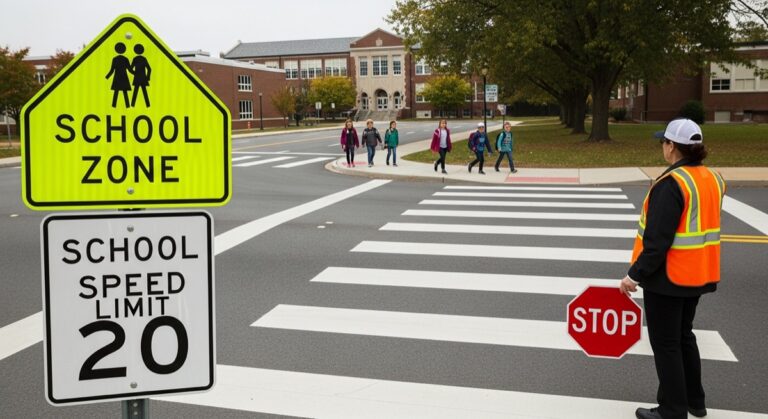
Per Section 7B.07, all school warning signs and school speed limit signs shall have a fluorescent yellow-green (FYG) background. This is not optional — it is a SHALL condition. The FYG color provides enhanced visibility during dawn and dusk when children are most likely to be walking to school. Signs that must use FYG include:
- School Advance Warning (S1-1)
- School Crossing (S1-1 with arrow plaque)
- School Speed Limit assemblies
- School zone supplemental plaques
School Speed Limit Assembly
The school speed limit assembly is defined in Section 7B.09 and consists of several components:
- SCHOOL SPEED LIMIT sign (S5-1) — displays the reduced speed limit that applies during school hours.
- “WHEN FLASHING” or “WHEN CHILDREN ARE PRESENT” plaque — defines when the reduced speed limit is in effect.
- Speed limit value — typically 15 or 20 mph, depending on state law.
Per Section 7B.09, a school speed limit assembly shall be installed at or as near as practical to the point where the reduced speed zone begins. A second assembly should be installed at the far end of the school zone to mark where the reduced speed limit ends, or an END SCHOOL ZONE (S5-2) sign may be used.
School Advance Warning Signs
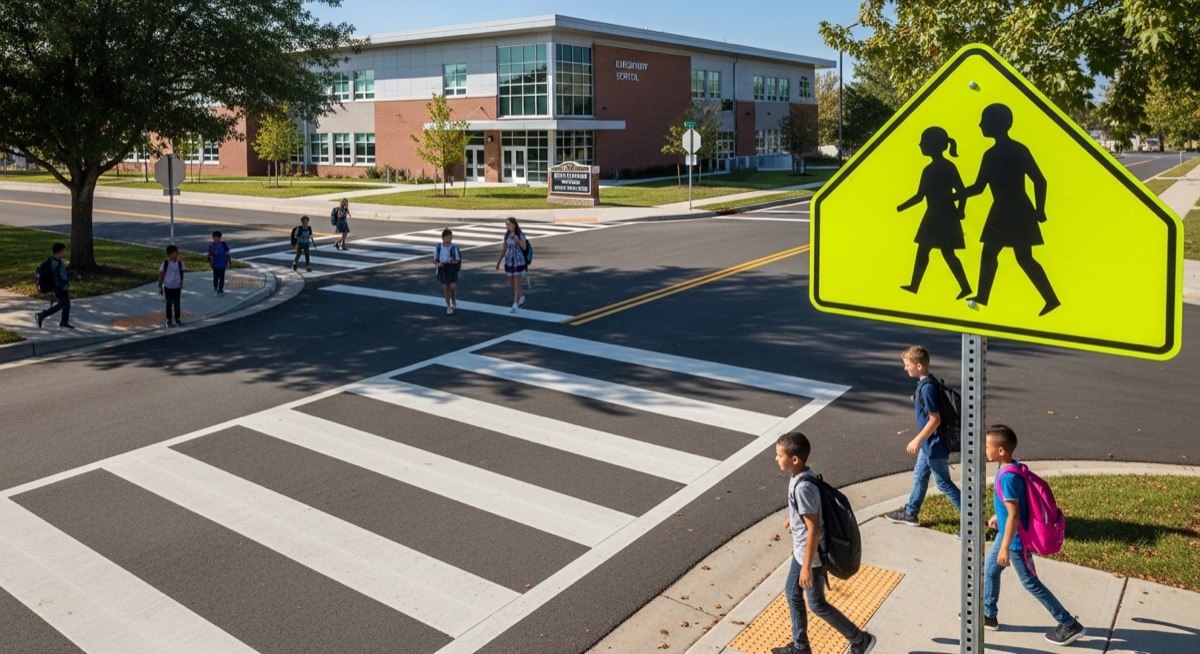
Per Section 7B.08, a School Advance Warning sign (S1-1) — the pentagon-shaped sign showing two pedestrian figures — shall be installed in advance of each school zone or school crossing. Placement distances follow the same guidelines as standard warning signs in Table 2C-4 (see the full MUTCD Part 2: Signs reference), typically:
- 100 feet minimum in advance on low-speed streets
- Up to 750 feet on higher-speed roads
The S1-1 sign has a unique pentagon shape (house-shaped, point up) that is used exclusively for school signs. No other sign type uses this shape, making it instantly recognizable.
School Crossing Signs and Markings
Per Section 7B.10, school crossings should be established at locations where a substantial number of school children cross. Requirements include:
- Crosswalk markings — high-visibility crosswalk markings (continental or ladder style) are recommended at school crossings per Section 7C.02 (see our pavement marking standards guide).
- School Crossing sign assembly — the S1-1 sign with a diagonal downward-pointing arrow plaque (W16-7P) installed at the crossing location.
- Stop lines — should be placed 4 feet in advance of the crosswalk per Section 7C.03.
School Zone Flasher Requirements
Flashing beacons are commonly used to supplement school speed limit signs. Per Section 7B.09:
- Warning beacons may be used to supplement school advance warning signs or school speed limit assemblies.
- When used, beacons shall flash only during the periods when the school speed limit is in effect.
- Beacons shall be circular yellow, with a minimum diameter of 8 inches (12 inches preferred).
- Beacon timing must be coordinated with actual school arrival and dismissal times. Flashing at incorrect times degrades driver compliance.
Rectangular Rapid Flashing Beacons (RRFBs) may also be used at school crossings to enhance pedestrian visibility, particularly at uncontrolled crosswalks. The 11th Edition MUTCD formally incorporates RRFBs as a standard device.
Adult Crossing Guards
Section 7D.01 addresses the use of adult crossing guards. Key requirements:
- Guards shall wear high-visibility safety apparel meeting ANSI/ISEA 107 Class 2 requirements (typically a retroreflective vest).
- Guards shall use a STOP paddle at least 18 inches wide with retroreflective material for use during reduced visibility.
- Guards should be trained in proper procedures for stopping traffic, escorting children, and positioning themselves safely.
- Guards should be positioned at the curb or edge of the roadway — not standing in the travel lane — until they are actively stopping traffic to cross children.
Reduced School Speed Limit Hours
One of the most common questions is when a school zone speed limit applies. The MUTCD provides two standard conditions per Section 7B.09:
- “WHEN FLASHING” — speed limit applies only when beacons are actively flashing.
- “WHEN CHILDREN ARE PRESENT” — speed limit applies whenever children are visible near the roadway, regardless of time.
Fixed time periods (e.g., “7:00-8:30 AM / 2:30-4:00 PM”) may also be posted using supplemental plaques, but the MUTCD recommends beacon-based or presence-based conditions because they automatically account for schedule changes.
Common Compliance Issues
- Using standard yellow instead of FYG — this is a SHALL violation since the 2009 MUTCD.
- Missing advance warning signs — the S1-1 must be placed in advance, not just at the crossing.
- Flashers running at wrong times — beacons must match actual school schedules.
- Faded or non-retroreflective signs — school signs must meet the same retroreflectivity standards as all other signs.
School zone compliance is a high-visibility issue for agencies. Parents, school administrators, and the public pay close attention to school zone safety. Keeping school zone signs and devices MUTCD-compliant is both a legal obligation and a community trust issue.