MUTCD Part 9: Traffic Control for Bicycle Facilities — Complete Reference Guide
Part 9 of the MUTCD covers traffic control devices specifically for bicycle facilities. As bicycling has grown as a transportation mode and active transportation infrastructure has expanded, Part 9 has become increasingly important. The 11th Edition significantly expanded this Part to address the full range of modern bicycle facility types, from shared roadways to protected bike lanes and cycle tracks.
What Part 9 Covers
Part 9 — Traffic Control for Bicycle Facilities — establishes standards for signs, markings, signals, and other traffic control devices used on bicycle facilities, including on-road bike lanes, protected bike lanes (cycle tracks), shared-use paths, bicycle boulevards/neighborhood bikeways, and shared roadways. It covers both the devices unique to bicycle facilities and the application of standard traffic control devices in bicycle contexts.
Key Chapters in Part 9
- Chapter 9A — General: Establishes the scope and purpose of Part 9, defines types of bicycle facilities, and outlines the principles governing bicycle-related traffic control devices. Includes definitions for bike lane, protected bike lane, shared-use path, bicycle boulevard, and shared roadway.
- Chapter 9B — Signs for Bicycle Facilities: Standards for all bicycle-related signs, including Bike Route signs (D11-1), Bike Lane signs (R3-17), shared lane markings-related signs, wayfinding signs, and warning signs for bicycle facilities. Covers both signs directed at bicyclists and signs directed at motorists regarding bicycle presence.
- Chapter 9C — Markings for Bicycle Facilities: Standards for bicycle lane markings (solid white line), bicycle lane word and symbol markings, shared lane markings (sharrows), colored pavement (green), bike boxes, two-stage turn queue boxes, intersection crossing markings, and buffered bike lane markings.
- Chapter 9D — Signals for Bicycle Facilities: Standards for bicycle signal faces (bicycle-shaped lens), detection of bicyclists at actuated signals, signal timing considerations for bicyclists, and the application of bicycle-specific signal phases.
Critical Standards (SHALL Requirements)
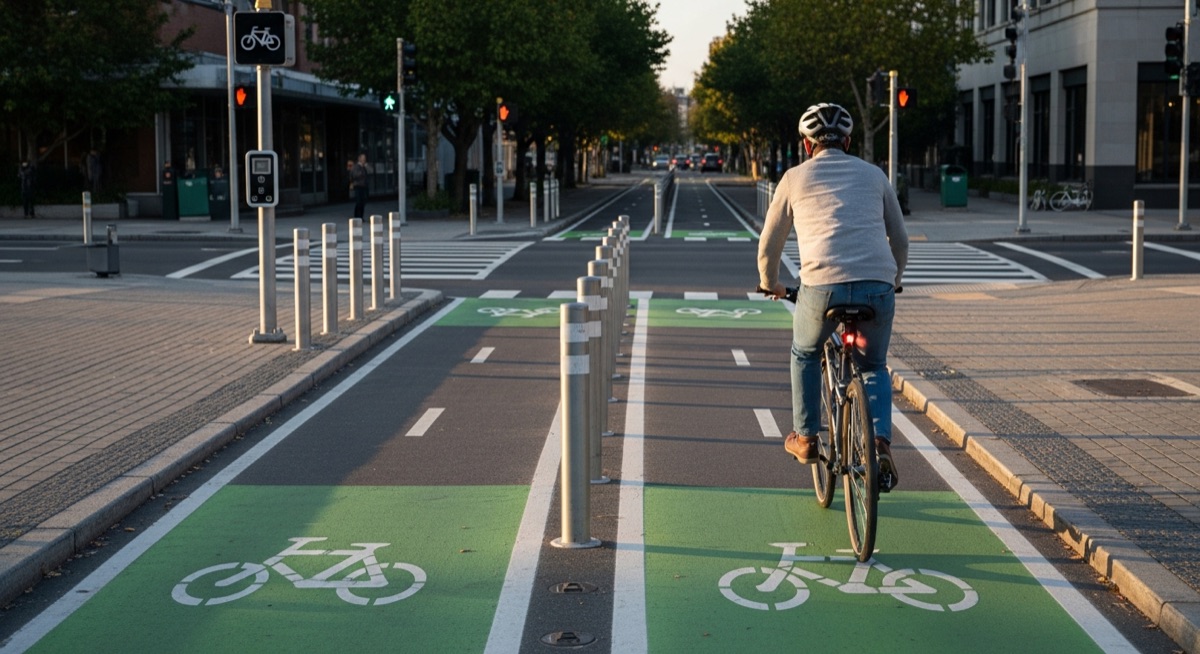
- Section 9C.01 — Bike Lane Markings: A bike lane SHALL be delineated by a solid white line marking along its length. The bike lane symbol marking (bicycle symbol) and/or the word marking “BIKE LANE” SHALL be placed within the bike lane at the beginning and at periodic intervals.
- Section 9C.02 — Buffered Bike Lane: If a buffered bike lane is provided, the buffer area SHALL be marked with two solid white lines and interior diagonal cross-hatching or chevron markings.
- Section 9C.04 — Shared Lane Markings (Sharrows): Shared lane markings SHALL NOT be placed on roads with speed limits above 35 mph. They SHALL be placed to direct bicyclists to the proper position within the travel lane, a minimum of 4 feet (1.2 m) from the face of the curb or edge of pavement (11 feet from the curb face where on-street parallel parking is present).
- Section 9C.05 — Green Colored Pavement: Where colored pavement is used to identify a bike lane or bicycle conflict zone, the color SHALL be green. Green colored pavement SHALL NOT be used to identify locations that are not bicycle facilities.
- Section 9B.02 — Bike Lane Sign (R3-17): A Bike Lane sign SHALL be installed at the beginning of a designated bike lane and MAY be installed at periodic intervals along the bike lane.
- Section 9D.02 — Bicycle Signal Faces: Where bicycle signal faces are used, they SHALL use the standard red/yellow/green lens configuration with a bicycle symbol on the lens. Bicycle signal faces SHALL comply with the applicable standards in Part 4.
- Section 9C.07 — Bike Box: Where a bike box is used at a signalized intersection, a “No Turn on Red” sign SHALL be installed for the motor vehicle approach, and the bike box area SHALL be marked with green colored pavement and a bicycle symbol.
Key Guidance (SHOULD Items)
- Bike lane markings SHOULD be at least 6 inches (150 mm) wide.
- Green colored pavement SHOULD be used at conflict zones where motor vehicle travel paths cross bike lanes (such as right-turn lanes, driveways, and merge areas).
- Bicycle detection at actuated traffic signals SHOULD be provided where bike lanes or bikeways approach signalized intersections.
- Bike route wayfinding signs SHOULD include destination, direction, and distance information.
- Where protected bike lanes are provided, intersection treatments SHOULD include protected intersection designs, bike signals, or other measures to manage turning conflicts.
- Two-stage turn queue boxes SHOULD be considered at intersections where bicyclists need to make left turns across multiple lanes of traffic.
Bicycle Facility Types and Traffic Control
| Facility Type | Key Markings | Key Signs |
|---|---|---|
| Conventional Bike Lane | Solid white line, bike symbol, “BIKE LANE” word marking | Bike Lane (R3-17), Begin/End Bike Lane |
| Buffered Bike Lane | Two solid white lines with hatching buffer, bike symbol | Bike Lane (R3-17) |
| Protected Bike Lane (Cycle Track) | Lane markings plus physical separation, green pavement at conflicts | Bike Lane (R3-17), regulatory signs at conflict points |
| Shared-Use Path | Yellow centerline (two-way path), edge lines, crosswalk markings at road crossings | Shared-Use Path (D11-1), regulatory and warning signs |
| Shared Roadway (Sharrows) | Shared lane marking (sharrow symbol) | Bikes May Use Full Lane (R4-11), Share the Road (W16-1) |
| Bicycle Boulevard / Neighborhood Bikeway | Shared lane markings, traffic calming markings | Bike Route (D11-1), wayfinding signs, traffic calming signs |
Bicycle-Specific Intersection Treatments
| Treatment | Description | Key Requirements |
|---|---|---|
| Bike Box | Designated area at head of traffic lane at signalized intersection for bicyclists to wait during red signal | Green pavement, No Turn on Red required, stop line set back |
| Two-Stage Turn Queue Box | Designated area for bicyclists making indirect (two-stage) left turns | Green pavement, bike symbol, turn arrow |
| Intersection Crossing Markings | Dashed green lines or dotted white lines through intersection | Guide bicyclists through complex intersections |
| Bicycle Signal Face | Signal head with bicycle symbol on the lens | Standard red/yellow/green configuration, bicycle symbol |
Compliance Dates
All new bicycle facility installations after January 18, 2024, SHALL comply with the 11th Edition. Existing bicycle facilities that were compliant with the 2009 Edition (or its interim approvals) are generally compliant and do not require immediate modification. When existing facilities are rehabilitated or modified, they SHALL be brought into compliance with the current edition.
What Changed in the 11th Edition
- Substantially expanded Part: Part 9 was significantly expanded compared to the 2009 Edition, reflecting the rapid growth in bicycle infrastructure nationwide.
- Green colored pavement standardized: Green colored pavement for bicycle facilities, previously an interim approval, is now a standard treatment in the 11th Edition.
- Bike boxes formalized: Bike boxes at signalized intersections are now included as a standard treatment with specific design requirements.
- Two-stage turn queue boxes added: Two-stage turn queue boxes are included as a standard treatment for facilitating bicyclist left turns.
- Bicycle signal faces standardized: Bicycle-specific signal faces with bicycle-shaped lenses are now a standard treatment (previously interim approval).
- Protected bike lane provisions: New provisions specifically addressing protected bike lanes (cycle tracks) and the traffic control devices needed for these facilities.
- Intersection crossing markings expanded: Enhanced standards for guiding bicyclists through intersections with dashed or dotted lines and colored pavement.
- Shared lane marking restrictions: Clarified that shared lane markings (sharrows) SHALL NOT be used on roads with speed limits above 35 mph, and enhanced placement guidance.
- Wayfinding guidance: New guidance for bicycle wayfinding sign systems, including destination, direction, distance, and travel time information.
Related Resources on mutcd.info
- Part 1: General Provisions — Reference Guide
- Part 2: Signs — Complete Reference Guide
- Part 3: Markings — Complete Reference Guide
- Part 4: Highway Traffic Signals — Reference Guide
- Bike Lane Marking Standards
- Green Colored Pavement for Bicycle Facilities
- Bicycle Signal Faces: Standards and Application
For the complete text of Part 9, visit the official FHWA MUTCD at mutcd.fhwa.dot.gov. The Part 9 PDF is available at mutcd.fhwa.dot.gov/pdfs/11th_Edition/part9.pdf.