
MUTCD Part 3: Markings — Complete Reference Guide
Part 3 of the MUTCD covers all pavement markings, curb markings, delineators, colored pavements, and other markings applied to the roadway surface or along the roadside. Markings are among the most fundamental traffic control devices, providing continuous guidance to drivers, separating opposing traffic, defining lanes, and communicating regulatory information directly on the road surface.
What Part 3 Covers
Part 3 — Markings — establishes standards for the design, application, colors, patterns, dimensions, and retroreflectivity of all roadway markings. This includes longitudinal lines (centerlines, lane lines, edge lines), transverse markings (stop lines, crosswalks, speed humps), word and symbol markings, colored pavements, raised pavement markers, and delineators. It also covers the retroreflectivity requirements that agencies must meet to maintain marking visibility at night.
Key Chapters in Part 3
- Chapter 3A — General: Establishes marking functions, colors (white, yellow, red, blue, purple), materials, retroreflectivity requirements, and maintenance standards. Defines the fundamental principles for when markings are required and how they must be maintained.
- Chapter 3B — Pavement and Curb Markings: The core chapter covering centerlines, lane lines, edge lines, no-passing zone markings, turn markings, crosswalks, stop lines, parking space markings, and curb markings. Contains the critical width, pattern, and gap specifications for each marking type.
- Chapter 3C — Raised Pavement Markers (RPMs): Standards for retroreflective and non-retroreflective raised pavement markers used to supplement or substitute for pavement markings, including color-coding requirements.
- Chapter 3D — Delineators: Covers post-mounted delineators used along roadway edges, at curves, and on structures. Includes spacing requirements and color standards (white for right side, yellow for left side of travel).
- Chapter 3E — Colored Pavements: Standards for colored pavement treatments, including red for transit-only lanes, green for bicycle facilities, and other applications.
Critical Standards (SHALL Requirements)
- Section 3A.01 — Functions and Marking Colors: Yellow markings SHALL separate opposing directions of travel. White markings SHALL separate same-direction travel, delineate the right edge of the roadway, and mark crosswalks and stop lines.
- Section 3A.02 — Standardization of Markings: Pavement markings SHALL conform to the standards in Part 3. Non-standard markings SHALL NOT be used.
- Section 3A.03 — Retroreflectivity: Agencies SHALL maintain pavement markings at or above minimum retroreflectivity levels as specified in Table 3A-1. Agencies SHALL use an assessment or management method to meet this requirement.
- Section 3B.01 — Yellow Centerline Markings: Centerline markings SHALL be placed on all paved two-way roadways with an ADT of 6,000 or more. A broken yellow centerline SHALL separate opposing travel where passing is permitted; a solid yellow line SHALL indicate no passing.
- Section 3B.04 — White Lane Line Markings: Lane lines SHALL be white. A normal broken white line SHALL separate same-direction lanes where lane changes are permitted. A solid white line SHALL discourage lane changes; a double solid white line SHALL prohibit lane changes.
- Section 3B.16 — Stop Lines: Stop lines SHALL be solid white, extending across approach lanes. They SHALL be at least 12 inches (300 mm) wide and SHOULD be 24 inches (600 mm) wide.
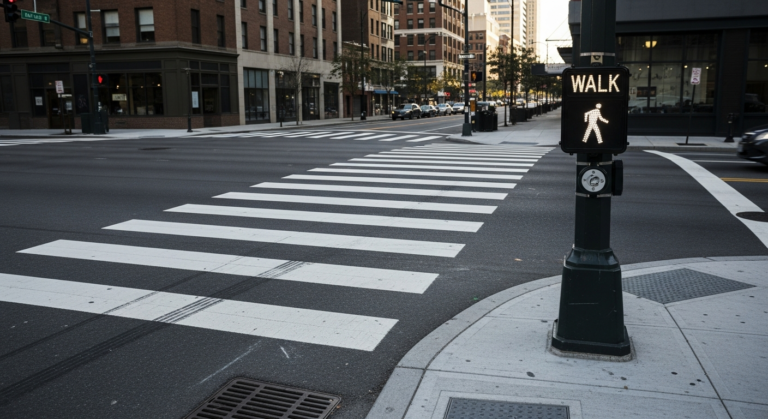
- Section 3B.18 — Crosswalk Markings: Where crosswalks are marked, they SHALL consist of solid white lines not less than 6 inches (150 mm) wide marking the boundaries of the crosswalk. Continental (ladder) or other high-visibility patterns are permitted.
Key Guidance (SHOULD Items)
- Centerline markings SHOULD be placed on all paved two-way roadways with an ADT of 3,000 or more.
- Edge lines SHOULD be placed on all paved roadways with a traveled way width of 20 feet (6.0 m) or more and an ADT of 6,000 or more.
- Crosswalks SHOULD be marked at all intersections where there is substantial pedestrian activity or where pedestrians could not reasonably be expected to recognize the crossing point.
- Continental (high-visibility) crosswalk markings SHOULD be used at uncontrolled crossings and school crossings.
- Lane lines SHOULD be at least 4 inches (100 mm) wide; 6-inch (150 mm) wide lines are preferred for better visibility.
Critical Marking Specifications
Standard Marking Colors and Applications
| Color | Application |
|---|---|
| Yellow | Centerlines, no-passing zones, left edge lines, two-way left-turn lane markings, raised medians |
| White | Lane lines, right edge lines, crosswalks, stop lines, word/symbol markings, channelizing lines |
| Red | Areas not to be entered or used (e.g., transit-only colored pavement) |
| Blue | Disabled parking spaces |
| Purple | Toll lanes, managed lanes (colored pavement) |
| Green | Bicycle lanes and conflict zones (colored pavement) |
Standard Line Widths and Patterns
| Marking Type | Width | Pattern (Line/Gap) |
|---|---|---|
| Normal broken line (centerline or lane line) | 4″ to 6″ (100-150 mm) | 10 ft line / 30 ft gap (3:1 ratio) |
| Dotted line (extension through intersection) | 4″ to 6″ | 2 ft line / 2-6 ft gap (shorter segments) |
| Edge line | 4″ to 6″ (normal), 6″ to 8″ (wide) | Solid (continuous) |
| Stop line | 12″ to 24″ (300-600 mm) | Solid |
| Crosswalk lines | 6″ to 24″ (150-600 mm) | Solid, parallel or continental pattern |
| Turn arrow | Per MUTCD standard dimensions | Standard arrow design per Figure 3B-21 |
Minimum Retroreflectivity for Pavement Markings (Table 3A-1)
| Road Type | Speed Limit | Minimum Retroreflectivity (mcd/m2/lx) |
|---|---|---|
| Roads with centerline and/or edge lines | > 35 mph | White: 50 / Yellow: 25 |
| Roads with centerline and/or edge lines | ≤ 35 mph | Maintained to be visible (no specific value) |
Note: Exact values and measurement conditions are specified in the full MUTCD. Agencies may use visual nighttime inspections, measured retroreflectivity, or expected service life as their management method.
Compliance Dates
The 11th Edition maintains and extends the retroreflectivity compliance requirements that were added to the 2009 Edition. Agencies must have an assessment or management method in place to maintain minimum retroreflectivity. New marking installations after January 18, 2024, SHALL comply with the 11th Edition standards.
What Changed in the 11th Edition
- Retroreflectivity requirements consolidated: The minimum maintained retroreflectivity levels are now more clearly presented in Table 3A-1, with specific values for different road types and speeds.
- Colored pavement expanded (Chapter 3E): Green colored pavement for bicycle facilities is now a standard treatment rather than an interim approval. Red colored pavement for transit lanes is formalized.
- High-visibility crosswalks emphasized: Continental/ladder-style crosswalk markings receive stronger guidance, particularly at uncontrolled crossings and school zones.
- Bicycle facility markings expanded: New marking standards for protected bicycle lanes, bike boxes, two-stage turn queue boxes, and intersection crossing markings. Coordinated with the expanded Part 9 (Bicycle Facilities).
- Roundabout markings: Enhanced guidance for markings at roundabouts, including yield lines, circulatory lane markings, and pedestrian crossings.
- Low-volume road provisions integrated: Content from the former Part 5 related to markings on low-volume roads has been incorporated into Part 3.
- Longitudinal marking warrant thresholds: Updated ADT thresholds for when centerlines and edge lines are required versus recommended.
Related Resources on mutcd.info
- Part 1: General Provisions — Reference Guide
- Part 2: Signs — Complete Reference Guide
- Part 9: Bicycle Facilities — Reference Guide
- Crosswalk Marking Standards and Best Practices
- Pavement Marking Retroreflectivity Requirements
For the complete text of Part 3, visit the official FHWA MUTCD at mutcd.fhwa.dot.gov. The Part 3 PDF is available at mutcd.fhwa.dot.gov/pdfs/11th_Edition/part3.pdf.