MUTCD Part 4: Highway Traffic Signals — Complete Reference Guide
Part 4 of the MUTCD covers the standards for highway traffic signals, including traffic control signals, pedestrian signals, beacons, and in-roadway lights. Traffic signals are the most complex and costly traffic control devices, and Part 4 provides the detailed warrants, design standards, and operational requirements that govern their installation and operation.
What Part 4 Covers
Part 4 — Highway Traffic Signals — addresses the full lifecycle of traffic signal systems: when they are warranted, how they must be designed and installed, operational requirements, signal timing considerations, pedestrian signal standards, and specialty applications like beacons and hybrid signals. It also covers accessible pedestrian signals (APS), flashing beacons, lane-use control signals, and in-roadway warning lights.
Key Chapters in Part 4
- Chapter 4A — General: Establishes the scope and purpose of traffic signal standards, the fundamental requirements for signal faces, lenses, and visibility, and the general principles governing signal operations.
- Chapter 4B — Traffic Control Signals — Warrants: Contains the nine signal warrants (Tables/Figures 4B-1 through 4B-9) that must be evaluated before a traffic signal can be installed. This is one of the most critical chapters in the entire MUTCD.
- Chapter 4C — Traffic Control Signal Needs Studies: Requirements for conducting engineering studies to determine if a traffic signal is justified, including data collection and analysis procedures.
- Chapter 4D — Traffic Control Signal Design: Technical standards for signal heads, lenses (8-inch and 12-inch), mounting, visibility, and positioning. Covers signal face configurations and the arrangement of signal indications.
- Chapter 4E — Pedestrian Control Features: Standards for pedestrian signal heads (WALKING PERSON / UPRAISED HAND symbols), pedestrian pushbuttons, accessible pedestrian signals (APS), pedestrian hybrid beacons (PHBs, formerly HAWK signals), and countdown timers.
- Chapter 4F — Traffic Control Signals for Emergency Vehicle Access: Standards for traffic signal preemption systems for emergency vehicles and railroad grade crossings.
- Chapter 4G — Traffic Control Signals for Freeway Entrance Ramps (Ramp Meters): Standards for ramp metering signals.
- Chapter 4H — Traffic Control Signals for One-Lane, Two-Way Facilities: Signal standards for alternating one-way traffic control.
- Chapter 4I — Flashing Beacons: Standards for flashing beacons, including intersection control beacons, warning beacons, speed limit sign beacons, and stop beacons.
- Chapter 4J — In-Roadway Lights: Standards for in-roadway warning lights at crosswalks and other locations.
- Chapter 4K — Lane-Use Control Signals: Standards for overhead lane-use control signals (green arrow down, red X, yellow X) used for reversible lanes and lane closure.
Traffic Signal Warrants (Chapter 4B)
The signal warrants are among the most important and frequently referenced sections of the MUTCD. A traffic signal SHALL NOT be installed unless one or more of these warrants is met:
| Warrant | Title | Key Criteria |
|---|---|---|
| 1 | Eight-Hour Vehicular Volume | Minimum volume thresholds on major and minor streets for 8 hours of an average day |
| 2 | Four-Hour Vehicular Volume | Volume combinations plotted against warrant curves for 4 hours of an average day |
| 3 | Peak Hour | Volume-based or delay-based criteria for the peak hour |
| 4 | Pedestrian Volume | Minimum pedestrian volumes crossing the major street with inadequate gaps |
| 5 | School Crossing | Pedestrian volumes at school crossings where adequate gaps are not available |
| 6 | Coordinated Signal System | Progressive signal coordination requires a signal at this location |
| 7 | Crash Experience | 5+ crashes correctable by a signal in a 12-month period, plus volume conditions |
| 8 | Roadway Network | Intersection is on a network route that merits signal control for overall operations |
| 9 | Intersection Near a Grade Crossing | Proximity to a railroad grade crossing creates queuing/safety concerns |
Critical Standards (SHALL Requirements)
- Section 4B.01 — Warrant Studies: An engineering study SHALL be performed before installing a traffic signal. The study SHALL evaluate all applicable warrants and consider the effects on safety and operations.
- Section 4B.01 — Warrant Satisfaction: A traffic signal SHALL NOT be installed unless at least one warrant is met. Meeting a warrant does not mandate installation — engineering judgment is required.
- Section 4D.04 — Signal Lens Size: Signal lenses for through-movement signal faces SHALL be 12 inches (300 mm) in diameter on approaches with speed limits of 45 mph or higher and on all signal faces controlling multi-lane approaches. 8-inch (200 mm) lenses MAY be used on lower-speed, lower-volume approaches.
- Section 4E.03 — Pedestrian Signal Timing: Pedestrian signals SHALL be timed to provide adequate crossing time. The walking speed used for calculating pedestrian clearance time SHALL be no more than 3.5 feet per second (1.1 m/s) — reduced from the previous 4.0 ft/s standard.
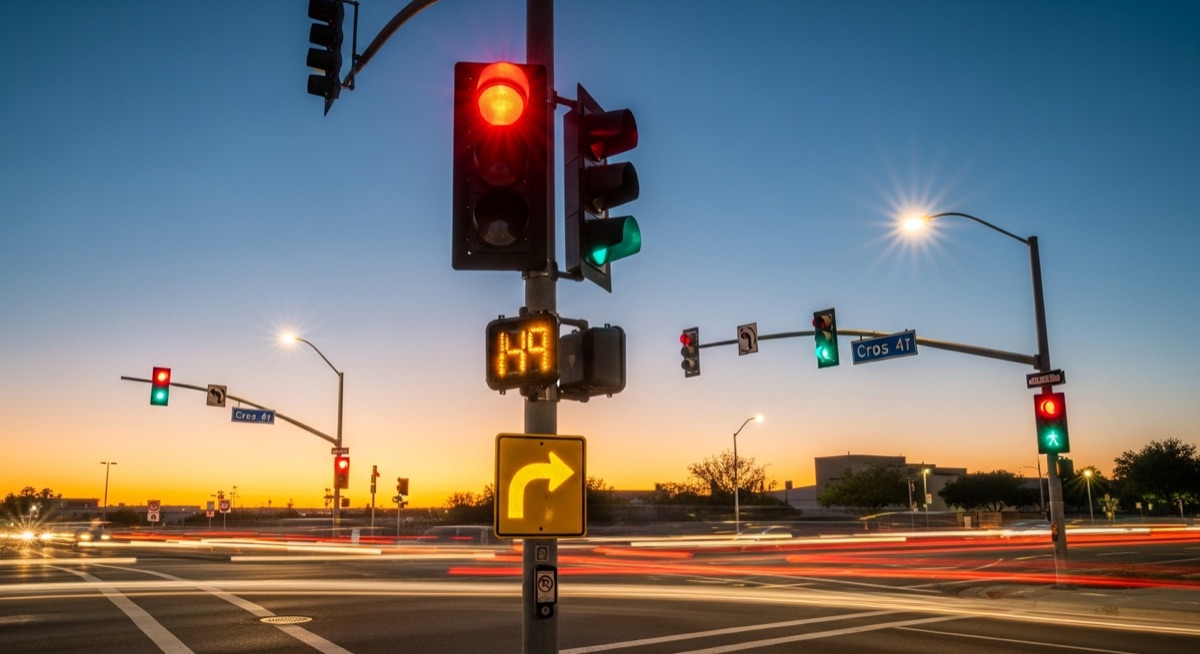
- Section 4E.06 — Countdown Pedestrian Signals: All pedestrian signal heads SHALL display a countdown indicating the number of seconds remaining in the pedestrian change interval.
- Section 4E.09 — Accessible Pedestrian Signals (APS): When pedestrian signals are installed or upgraded at locations with pedestrian pushbuttons, APS features SHALL be considered and SHOULD be provided where engineering judgment determines they would serve pedestrians with visual or cognitive disabilities.
- Section 4D.11 — Yellow Change Interval: The yellow change interval SHALL have a minimum duration of 3 seconds and a maximum of 6 seconds, determined by engineering practices.
Key Guidance (SHOULD Items)
- Traffic signal installations SHOULD include countdown pedestrian signals on all crosswalks served by the signal.
- Left-turn phasing SHOULD be provided where left-turn crash patterns or volume-to-capacity conditions indicate a need.
- Protected-only left-turn mode SHOULD be used where sight distance is restricted or opposing volumes are high.
- A “No Turn on Red” sign SHOULD be installed where right-turn-on-red conflicts with pedestrian movements are frequent.
- Signal timing SHOULD be reviewed on a regular cycle (3 to 5 years) to ensure optimal operations.
Pedestrian Hybrid Beacons (PHBs)
The 11th Edition continues to include the Pedestrian Hybrid Beacon (PHB), previously known as the HAWK signal. PHBs provide a high-level stop control for pedestrians crossing major streets at midblock or uncontrolled locations. Section 4E.12 establishes the warrants and operational standards for PHBs, including the unique signal sequence (dark / flashing yellow / steady yellow / steady red / alternating flashing red / dark).
Compliance Dates
- Countdown pedestrian signals: All new pedestrian signal installations SHALL include countdown displays. Existing signals SHOULD be upgraded when signal heads are replaced.
- 12-inch signal lenses: New or reconstructed signal installations on high-speed or multi-lane approaches SHALL use 12-inch lenses.
- Walking speed reduction: The reduced walking speed of 3.5 ft/s for pedestrian timing calculations applies to all new signal timing implementations and SHALL be applied when timing is revised at existing signals.
What Changed in the 11th Edition
- Pedestrian walking speed reduced: The default walking speed for calculating pedestrian clearance intervals was reduced from 4.0 ft/s to 3.5 ft/s, providing more crossing time for slower pedestrians.
- Leading Pedestrian Interval (LPI): New provisions encourage the use of LPIs to give pedestrians a head start before conflicting vehicle movements receive a green indication.
- Accessible Pedestrian Signals (APS): Strengthened provisions for APS, aligning with updated accessibility guidelines. APS are now more strongly recommended at signalized intersections with pedestrian pushbuttons.
- Pedestrian Hybrid Beacons expanded: PHB warrants were updated and the PHB is more firmly established as a standard treatment option.
- Flashing Yellow Arrow (FYA): The Flashing Yellow Arrow for permitted left turns is fully codified in the 11th Edition (it was previously an interim approval). FYA is now a standard left-turn signal display option.
- Rectangular Rapid Flashing Beacons (RRFBs): RRFBs are included as a standard treatment in the 11th Edition, after previously being covered under interim approval.
- Signal warrant adjustments: Warrant thresholds were reviewed and some volume thresholds were adjusted. The pedestrian volume warrant now better accounts for vulnerable road user needs.
- Right-turn-on-red restrictions: Enhanced guidance on restricting right-turn-on-red at locations with significant pedestrian activity.
Related Resources on mutcd.info
- Part 1: General Provisions — Reference Guide
- Part 2: Signs — Complete Reference Guide
- Traffic Signal Warrants Explained
- Pedestrian Hybrid Beacon (PHB/HAWK) Guide
- Flashing Yellow Arrow Left-Turn Signals
- Part 7: Traffic Control for School Areas
- Part 8: Railroad Grade Crossings
For the complete text of Part 4, visit the official FHWA MUTCD at mutcd.fhwa.dot.gov. The Part 4 PDF is available at mutcd.fhwa.dot.gov/pdfs/11th_Edition/part4.pdf.