
MUTCD Pavement Marking Standards — Colors, Widths, and Patterns
Pavement markings are among the most important traffic control devices on the road. Unlike signs, markings are directly in the driver’s line of sight and provide continuous guidance, especially at night and in adverse weather. MUTCD Part 3 (Markings) establishes the national standards for pavement marking colors, widths, patterns, and applications.
Color Standards
Per Section 3A.02, the MUTCD defines four pavement marking colors, each with a specific meaning:
- White — Separates traffic flowing in the same direction, delineates the right edge of the roadway, and marks crosswalks, stop lines, and parking spaces.
- Yellow — Separates traffic flowing in opposite directions and delineates the left edge of divided highways. Yellow is also used for no-passing zones.
- Red — Marks areas where entry is prohibited (e.g., wrong-way on a one-way facility). Red markings are not common but are permitted.
- Blue — Supplements disabled parking space markings. Used for the International Symbol of Accessibility stencil.
The single most important rule: yellow separates opposing traffic; white separates same-direction traffic. Getting this wrong creates a serious safety hazard.
Line Patterns and Their Meanings
Per Section 3B.02, the pattern of a line communicates whether crossing or lane changing is permitted:
- Broken (dashed) line — Permissive. Crossing or lane changing is allowed.
- Solid line — Restrictive. Crossing is discouraged (white) or prohibited (yellow).
- Double solid lines — Crossing is prohibited from both directions.
- Combination (one solid, one broken) — Crossing is permitted from the broken-line side only.
- Dotted line — A shorter dash pattern used for lane-line extensions through intersections and to guide lane changes in complex areas.
Standard Line Widths
Per Section 3A.05, standard line widths are:
- Normal width — 4 to 6 inches (minimum 4 inches)
- Wide line — at least twice the normal width (typically 8-12 inches). Used for emphasis, such as at lane drops or sharp curves.
- Edge lines — minimum 4 inches on freeways and expressways; may be wider for enhanced visibility.
The standard broken-line pattern is a 10-foot line segment with a 30-foot gap (10:30 ratio) per Section 3B.08. Some states use a 3:9 or 15:25 pattern — always verify with your state supplement. For 11th Edition compliance dates, see our dedicated guide.
Center Line Markings
Per Section 3B.01, center line markings shall be placed on all paved roadways with ADT of 6,000 or more and should be placed on roads with ADT above 3,000. Center line markings are always yellow. Configurations include:
- Broken yellow — passing permitted in both directions.
- Solid yellow + broken yellow — passing permitted from the broken-line side only.
- Double solid yellow — no passing in either direction.
Crosswalk Markings
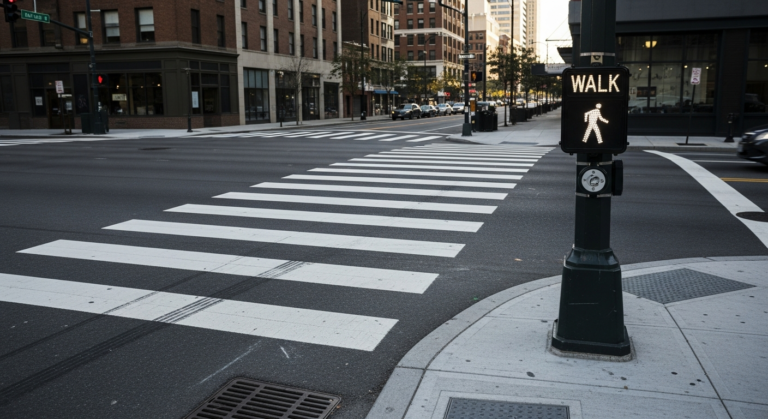
Per Section 3B.18, crosswalk markings consist of white lines at least 6 inches wide. The MUTCD permits two primary styles:
- Standard (transverse lines) — Two parallel white lines marking the edges of the crosswalk, spaced at least 6 feet apart.
- High-visibility (continental/ladder) — White bars perpendicular to the path of travel, typically 12-24 inches wide with 12-24 inch gaps. Per Section 3B.18, high-visibility markings are recommended where enhanced visibility is desired, particularly at uncontrolled locations and school crossings.
Crosswalk markings alone do not ensure pedestrian safety. On multi-lane roads, crosswalk markings should be accompanied by appropriate signs, beacons, or signals.
Stop Lines and Yield Lines
Per Section 3B.16:
- Stop lines are solid white, 12 to 24 inches wide, placed across approach lanes at signalized intersections or STOP sign-controlled intersections. They should be placed at least 4 feet in advance of the nearest crosswalk line.
- Yield lines (shark’s teeth) consist of a row of solid white triangles pointing toward approaching traffic, used at roundabouts and yield-controlled intersections per Section 3B.16.
Turn Arrow Markings
Per Section 3B.20, lane-use arrow markings indicate mandatory or permitted movements in specific lanes. Arrow designs must conform to the dimensions in Figure 3B-24. Standard arrows include straight, left turn, right turn, and combination arrows. Arrows should be white and are typically placed at least twice in the approach lane — once near the intersection and once farther upstream.
Retroreflectivity and Durability
Per Section 3A.03, all pavement markings that are required to be visible at night shall be retroreflective unless ambient illumination makes retroreflectivity unnecessary. Retroreflectivity is achieved through glass beads embedded in the marking material. Common marking materials include:
- Waterborne paint — lowest cost, shortest life (3-12 months depending on traffic).
- Thermoplastic — durable, 3-5 year life, good retroreflectivity.
- Preformed tape — highest retroreflectivity and durability, but highest cost.
- Epoxy — durable, 3-5 year life, good adhesion.
Selecting the right marking material depends on traffic volume, climate, budget, and the criticality of the marking location. High-volume, high-speed roads justify the investment in more durable materials.