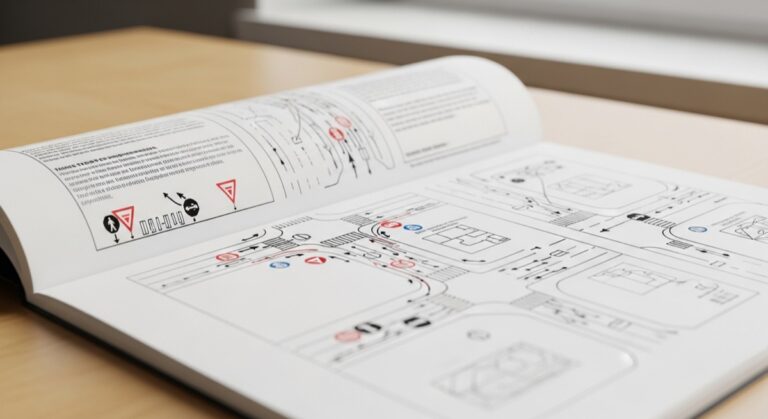

How to Read MUTCD Text — Standard vs Guidance vs Option vs Support
The MUTCD is a legal document, and its language is precise. Every sentence in the manual is classified into one of four categories — Standard, Guidance, Option, or Support — each carrying a different level of obligation. Misunderstanding these categories is one of the most common mistakes (learn about the 11th Edition changes) made by engineers, contractors, and agency staff working with the MUTCD.
This guide explains what each category means, how to identify them, and what the legal implications are for your agency.
The Four Categories — Defined in Section 1A.13
Section 1A.13 of the MUTCD (covered in our Part 1: General Provisions reference) defines the four types of text and their associated keyword verbs. Each category is typographically distinguished in the manual to help readers quickly identify the obligation level.
Standard — SHALL, SHALL NOT, REQUIRE, REQUIRED
A Standard statement describes a mandatory condition. When the MUTCD says something “shall” be done, it must be done. There is no engineering judgment involved — compliance is required.
- Keywords: SHALL, SHALL NOT, REQUIRE, REQUIRED
- Typographic style: Bold black text, with the heading “Standard:” in the margin.
- Example: “STOP sign faces shall be retroreflective or illuminated to show the same shape and similar color both day and night.”
- What it means: You must do this. There is no discretion. Deviation requires a formal request to experiment approved by the FHWA. For key dates, see our compliance dates guide.
Guidance — SHOULD, SHOULD NOT, RECOMMENDED
A Guidance statement describes a recommended condition. Engineering judgment may be applied, but deviations should be documented and based on an engineering study or engineering judgment.
- Keywords: SHOULD, SHOULD NOT, RECOMMENDED
- Typographic style: Regular black text, with the heading “Guidance:” in the margin.
- Example: “If used, warning beacons should be used only during those periods of the day when the school speed limit is in effect.”
- What it means: You should do this unless there is a documented engineering reason not to. Routine deviation without documentation is problematic.
Option — MAY, MAY NOT, OPTIONAL
An Option statement describes a permissive condition. The practice is allowed and described in the MUTCD, but there is no obligation to use it.
- Keywords: MAY, MAY NOT, OPTIONAL
- Typographic style: Regular black text, with the heading “Option:” in the margin.
- Example: “A YIELD sign may be installed at a passive grade crossing.”
- What it means: You can do this if you want to, but you do not have to. Engineering judgment determines whether the option is appropriate for a specific location.
Support — IS, ARE, IT IS, WAS (No Action Verbs)
A Support statement provides informational or explanatory content. It does not prescribe any action. Support statements give background, research findings, or clarifying information.
- Keywords: No mandatory, recommended, or permissive verbs. Uses descriptive language — IS, ARE, WAS, etc.
- Typographic style: Regular black text, with the heading “Support:” in the margin.
- Example: “Approximately 50 percent of all fatal crashes occur at night.”
- What it means: This is background information. It does not require, recommend, or permit anything.
Why This Matters — Legal and Practical Implications
Understanding the MUTCD text hierarchy has real consequences:
- Tort liability. In lawsuits following traffic crashes, attorneys routinely examine whether the responsible agency complied with MUTCD Standards. A SHALL violation is a powerful piece of evidence for the plaintiff. SHOULD violations are also cited, but agencies can defend them with documented engineering judgment.
- Federal-aid eligibility. Under 23 CFR 655.603, all traffic control devices on roads open to public travel shall conform to the MUTCD. Non-compliance can jeopardize federal funding.
- State compliance. Most states adopt the MUTCD by reference (with or without a state supplement). A MUTCD Standard is typically enforceable under state law.
- Professional practice. Licensed engineers have a professional obligation to follow recognized standards. Ignoring SHALL requirements without an approved experiment is a practice risk.
How to Read the MUTCD Effectively
When reviewing any MUTCD section, follow this process:
- Identify all Standard (SHALL) statements first. These are your non-negotiable requirements. Build your design or installation plan around these.
- Review Guidance (SHOULD) statements next. Plan to follow these unless you have a specific, documentable reason to deviate.
- Evaluate Option (MAY) statements. Determine whether any optional practices would benefit your specific location based on engineering judgment.
- Read Support statements for context. These help you understand the reasoning behind the Standards and Guidance.
Common Misunderstandings
- “SHOULD means we can ignore it.” Wrong. SHOULD means you should do it unless engineering judgment and documentation support a different approach. Casually ignoring SHOULD statements is risky.
- “MAY means we should do it.” Wrong. MAY means it is permitted, not recommended. Do not treat Options as Guidance.
- “The MUTCD is just a guideline.” Wrong. The MUTCD is the national standard per federal regulation. Standards (SHALL) have the force of law on federal-aid highways.
- “Our state does it differently.” Possibly correct — but only if the state has a formal supplement. State supplements can add to the MUTCD but cannot reduce Standards.
Reading the MUTCD correctly is a foundational skill for anyone involved in traffic control device selection, design, or installation. When in doubt about a specific requirement, refer to the text category headings in the margin — they will tell you exactly how much obligation is attached to each statement.