Pedestrian safety is a growing priority in traffic engineering, and the MUTCD dedicates significant attention to crosswalk markings, pedestrian signals, and warning devices. Whether you are designing a new crossing or evaluating an existing one, understanding the federal standards for pedestrian crossings and crosswalks is essential. This guide covers crosswalk markings, pedestrian signals, Rectangular Rapid Flashing Beacons (RRFBs), and Pedestrian Hybrid Beacons (PHBs) under the MUTCD.
Crosswalk Marking Patterns
Section 3B.18 of the MUTCD establishes the standards for crosswalk markings. A marked crosswalk consists of white lines that define the pedestrian path across the roadway. The MUTCD recognizes several marking patterns:
- Standard (transverse) lines: Two parallel white lines running perpendicular to the direction of traffic, with the space between them (typically 6 feet minimum) defining the crosswalk. This is the minimum marking required.
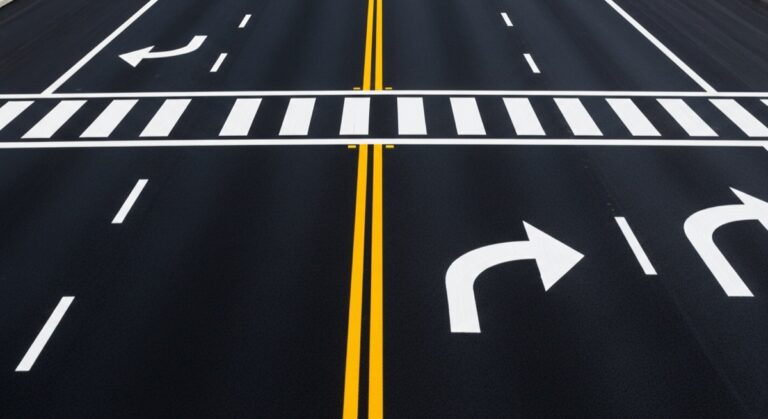
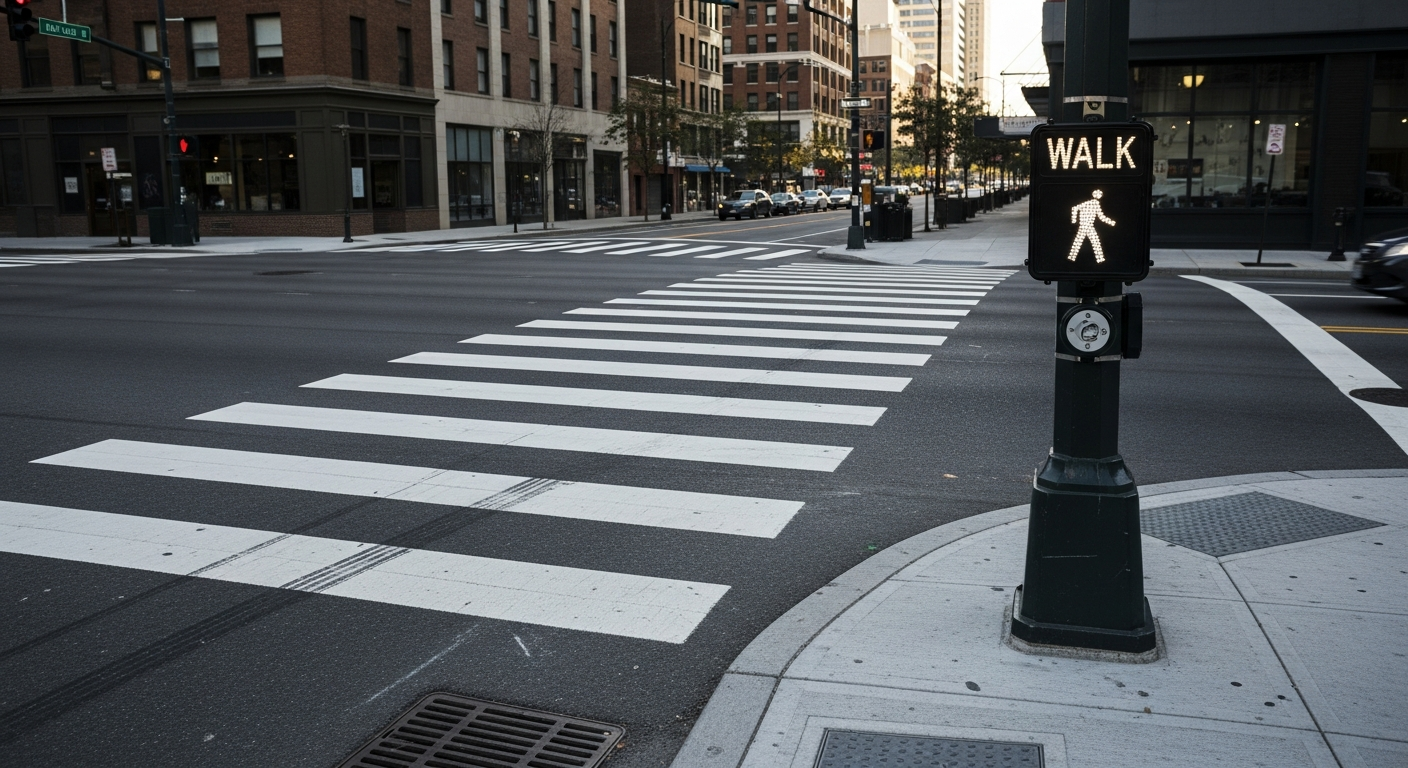
- Continental (ladder/bar) pattern: White bars running parallel to the direction of traffic, placed between the transverse boundary lines. This pattern is substantially more visible to approaching drivers and is the recommended pattern under the 11th Edition.
- Diagonal pattern: White bars placed at an angle between the boundary lines, offering improved visibility over the standard pattern.
The 11th Edition MUTCD strengthened the recommendation for high-visibility patterns, particularly at uncontrolled crossings and school crossings. All crosswalk lines must be white, with a minimum width of 6 inches for the transverse lines and 12 inches (preferred 24 inches) for the longitudinal bars in continental patterns. For broader context on marking standards, see our pavement marking standards guide.
When Should Crosswalks Be Marked?
The MUTCD provides guidance on when marking a crosswalk is appropriate. Crosswalks should generally be marked at all intersections where there is substantial pedestrian activity or where pedestrians might not otherwise recognize the preferred crossing location. Section 3B.18 notes that crosswalk markings should be considered at:
- Signalized intersections
- Approaches controlled by STOP or YIELD signs
- Locations where pedestrian volumes are significant
- School crossings and near facilities generating pedestrian traffic
- Mid-block crossings where an engineering study supports the installation
At uncontrolled locations on multi-lane roads (4+ lanes), simply marking a crosswalk without additional treatments such as signals, beacons, or median refuges is generally not recommended, as research has shown that marked crosswalks alone on high-volume multi-lane roads can create a false sense of security for pedestrians.
Pedestrian Signals (Section 4E)
MUTCD Part 4, Section 4E covers pedestrian signal heads and their timing. Modern pedestrian signals display three intervals:
- WALKING PERSON (steady): The white walking person symbol indicates the pedestrian may begin crossing.
- UPRAISED HAND (flashing): The flashing orange hand indicates the pedestrian should not begin crossing but may complete their crossing if already in the crosswalk.
- UPRAISED HAND (steady): The steady orange hand indicates the pedestrian shall not enter the crosswalk.
Pedestrian signal timing must provide enough time for a pedestrian to cross the entire roadway. The MUTCD uses a walking speed of 3.5 feet per second (reduced from 4.0 fps in earlier editions) to calculate the pedestrian clearance interval. Countdown timers, which display the number of seconds remaining in the flashing clearance interval, are now required for all new or replaced pedestrian signal heads. For a broader overview of signal requirements, see our traffic signal warrants guide.
Rectangular Rapid Flashing Beacons (RRFBs)
The 11th Edition MUTCD formally incorporates Rectangular Rapid Flashing Beacons (RRFBs) in Chapter 4J, giving them official status after years of interim approval. RRFBs are pedestrian-activated amber LED devices mounted on pedestrian crossing warning signs (W11-2 or school crossing assemblies) at uncontrolled crosswalks.
Key RRFB requirements include:
- RRFBs shall only be used to supplement pedestrian or school crossing warning sign assemblies at crosswalks
- They shall use a rapid flashing pattern of irregular pulses (not a standard flash rate)
- RRFBs must be installed on both sides of the roadway (or on both the right side and the median)
- They shall be activated by pedestrians, either by pushbutton or passive detection
- RRFBs shall not be used at crosswalks controlled by YIELD signs, STOP signs, or traffic signals
Research consistently shows that RRFBs achieve driver yielding rates of 80% or higher, making them a cost-effective alternative to full signals or PHBs at many locations.
Pedestrian Hybrid Beacons (PHBs)
Section 4F of the MUTCD covers Pedestrian Hybrid Beacons (formerly called HAWK signals). A PHB is a special type of beacon used to help pedestrians cross higher-speed or higher-volume roads at mid-block locations or uncontrolled intersections. The PHB displays a unique sequence:
- Dark (no display): Normal condition — drivers proceed normally.
- Flashing yellow: Activated by a pedestrian — warns drivers to prepare to stop.
- Steady yellow: Drivers should prepare to stop.
- Steady red (both lenses): Drivers must stop — pedestrians have the WALKING PERSON signal.
- Alternating flashing red: Drivers may proceed after stopping if the crosswalk is clear.
PHBs have their own set of warrants based on pedestrian volume, vehicle speed, and the number of lanes. The 11th Edition key changes expanded PHB applicability and refined the warrant thresholds. Studies show PHBs reduce pedestrian crashes by approximately 55% compared to uncontrolled crossings.
Choosing the Right Pedestrian Crossing Treatment
The appropriate crossing treatment depends on road characteristics and pedestrian demand. The MUTCD and FHWA guidance suggest a hierarchy of treatments:
- Low-volume, low-speed roads: Marked crosswalk with signs may suffice
- Moderate-volume roads: Add RRFBs or advance yield markings and signs
- High-volume or multi-lane roads: Consider a PHB or full traffic signal
- Very high speeds (45+ mph): Grade-separated crossing or PHB/signal strongly recommended
Median refuge islands, curb extensions, raised crosswalks, and adequate lighting are complementary treatments that the MUTCD encourages alongside marked crosswalks. Whatever treatment is chosen, ongoing maintenance of the pavement markings and signs is essential — faded markings and poor sign retroreflectivity reduce the effectiveness of any pedestrian crossing.