Roundabouts have become an increasingly popular intersection design in the United States, and the MUTCD provides detailed requirements for signing and marking these circular intersections. Proper signing and pavement markings are essential for guiding drivers safely through a roundabout, especially for first-time users unfamiliar with the geometry. This article covers the MUTCD standards for roundabout approach signs, yield control, lane markings, and pedestrian considerations.
Roundabout Approach Signing
Section 2B.43 and the W2-6 sign series in the MUTCD govern advance warning signs for roundabouts. The circular intersection warning sign (W2-6) must be placed in advance of every roundabout to alert drivers that a circular intersection lies ahead. Key approach signing requirements include:
- W2-6 (Circular Intersection) warning sign: A yellow diamond-shaped sign with a circular arrow symbol, required on each approach. An advisory speed plaque (W13-1p) may be used below the W2-6 sign when the recommended approach speed is significantly lower than the prevailing speed.
- Chevron alignment signs (W1-8): Yellow chevron signs placed around the central island to guide drivers through the circular roadway. These are especially important at night and at roundabouts with higher design speeds.
- Advance street name signs: Recommended on approaches to multi-leg roundabouts so drivers can identify their intended exit before entering.
For a broader look at sign colors and their meanings, yellow is consistently used for warning signs throughout the MUTCD, including all roundabout approach signs.
Yield Signs at Roundabout Entries
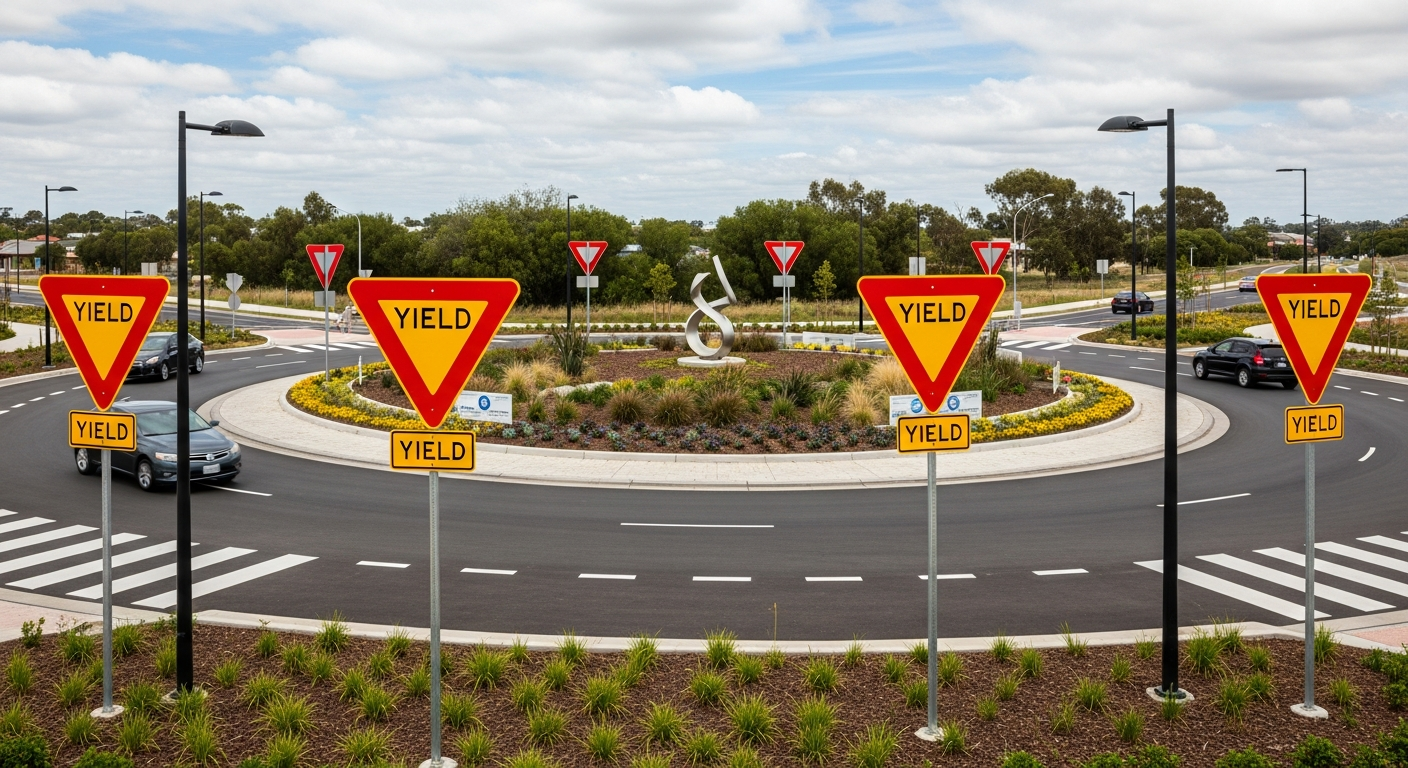
Every entry point into a roundabout must be controlled by a YIELD sign (R1-2), as specified in Section 2B.43. The yield sign is placed at the right side of the entry at or near the yield line. For multi-lane roundabout entries, a second yield sign on the left side (splitter island) is recommended for additional visibility.
The yield line itself is a series of white triangles (shark teeth) placed across the entry lanes, with the triangles pointing toward approaching traffic. This marking is covered in Section 3B.16 and must be used at all roundabout entries. For full details on yield sign requirements and compliance dates, see our dedicated article.
Lane Assignment and Guide Signs
Multi-lane roundabouts require additional signing to help drivers select the correct lane before entering. The MUTCD addresses this through:
- Lane assignment signs (R3 series): These signs use arrows to indicate which lane(s) may be used for each destination or turning movement. They should be placed on the approach in advance of the roundabout.
- Roundabout directional arrow signs: The R6-5p (ONE WAY) or roundabout-specific directional signs may be placed on the central island to reinforce the counterclockwise traffic flow.
- Guide signs: Destination and route signs should be placed on the approach and, where space allows, between the exit and the next intersection.
Pavement Markings at Roundabouts
Pavement markings at roundabouts serve to channelize traffic and define lanes. Section 3B addresses the following markings relevant to roundabouts:
- Yield lines: White triangular (shark teeth) markings at each entry, as described above.
- Circulatory lane markings: White dashed lane lines within the circulatory roadway of multi-lane roundabouts. These help drivers maintain lane position through the circle.
- Approach lane lines: White lane markings on multi-lane approaches that align with the circulatory lane lines.
- Crosswalk markings: High-visibility continental-style crosswalks placed one car length (approximately 20-25 feet) upstream from the yield line at each leg.
- Truck apron markings: If a truck apron (traversable raised area around the central island) is present, markings or different surface texture should clearly distinguish it from the travel lanes.
For complete pavement marking specifications including line widths and materials, refer to our pavement marking standards guide.
Pedestrian Crossings at Roundabouts
Pedestrian crossings at roundabouts are positioned on each leg, set back from the circulatory roadway by approximately one vehicle length. This setback allows a vehicle exiting the roundabout to stop for pedestrians without blocking the circulatory flow. Key requirements include:
- Pedestrian crossing signs (W11-2 or R1-6) placed at each crossing location
- High-visibility crosswalk markings (continental pattern preferred)
- Pedestrian refuge on the splitter island, with detectable warning surfaces (truncated domes) at each curb ramp
- Accessible pedestrian features per ADA requirements, including properly aligned curb ramps and tactile guidance
Mini-Roundabouts
The 11th Edition MUTCD recognizes mini-roundabouts — smaller circular intersections with fully traversable central islands, typically used in lower-speed residential or commercial areas. Mini-roundabouts generally have inscribed circle diameters of 45 to 90 feet. Signing requirements are similar to standard roundabouts, with yield signs at entries and the W2-6 advance warning sign, but the central island is typically a raised dome or painted circle that large vehicles can drive over. Mini-roundabouts offer many of the same safety benefits as full-size roundabouts, including reduced crash severity, lower speeds, and fewer conflict points.
Summary
Proper MUTCD-compliant signing and marking is critical to roundabout safety and operations. From advance warning signs and yield control to lane markings and pedestrian crossings, each element works together to guide all road users through the intersection. As roundabout construction continues to grow across the country, agencies should review the 11th Edition changes for the latest requirements and ensure their installations meet current standards.