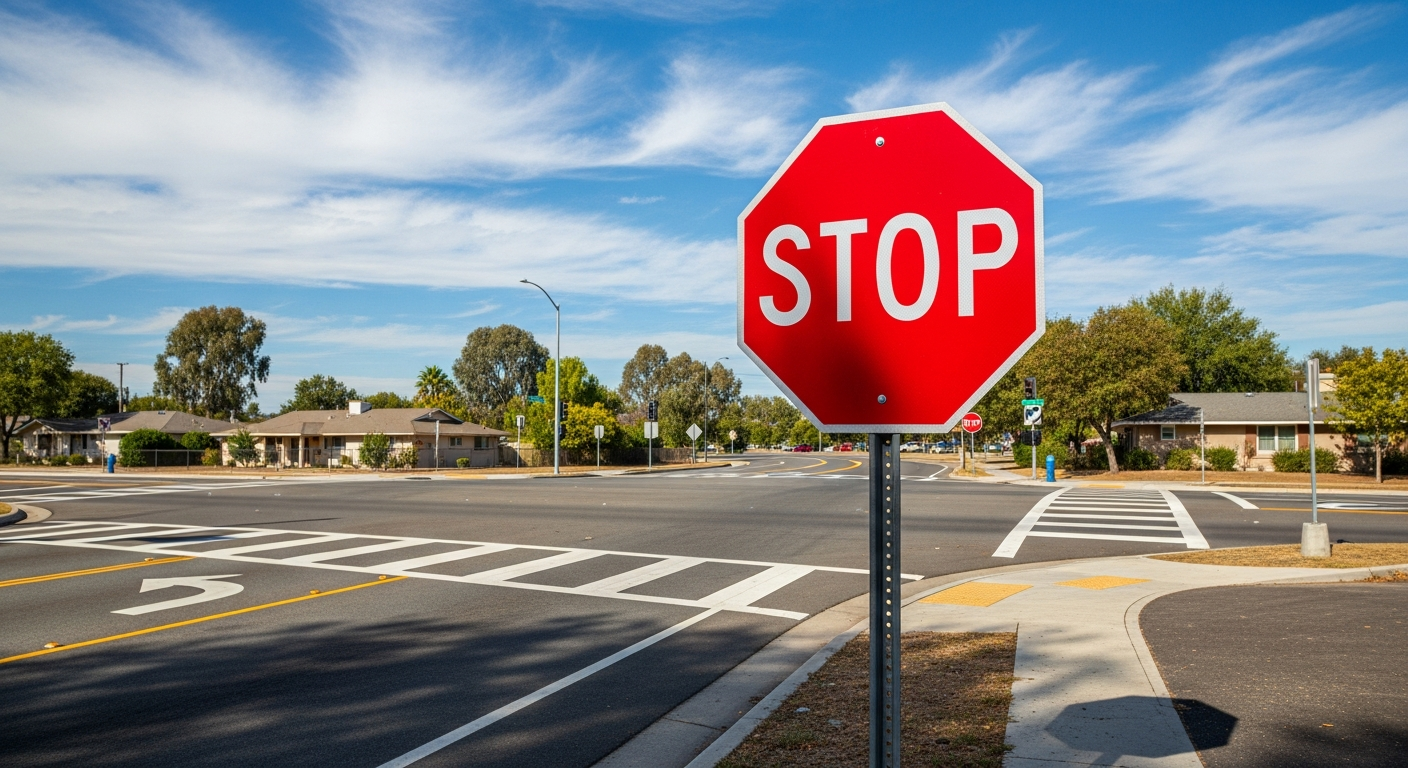
The STOP sign is the most recognizable traffic control device in the United States, and its requirements are among the most detailed in the Manual on Uniform Traffic Control Devices (MUTCD). From sign dimensions and retroreflectivity to mounting height and lateral placement, every aspect of STOP sign installation is governed by specific standards. This guide covers the key MUTCD requirements for STOP signs under the 11th Edition.
When Is a STOP Sign Required?
MUTCD Sections 2B.04 through 2B.10 establish when STOP signs (R1-1) shall, should, or may be installed. A STOP sign is required at intersections where an engineering study indicates that one or more of the following conditions exist:
- An intersection of a less important road with a main road where applying the normal right-of-way rule would not be expected to provide reasonable compliance
- A street or road entering a through highway or street
- An unsignalized intersection in a signalized area
- An intersection where a combination of high speed, restricted view, and serious crash record indicates a need for control by the STOP sign
Importantly, the MUTCD states that STOP signs shall not be used for speed control. Multi-way stop installations (Section 2B.07) have their own set of warrants, including minimum traffic volume thresholds and crash history criteria.
Standard STOP Sign Sizes
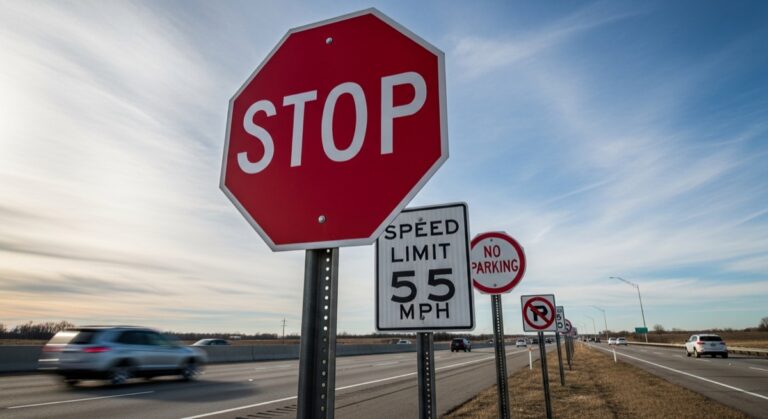
The MUTCD specifies STOP sign dimensions based on the type of roadway. All STOP signs use the standard octagonal shape with white legend on a red background. The standard regulatory sign sizes reference provides a broader look at all sign dimensions.
| Road Type | Minimum Size |
|---|---|
| Single-lane conventional road | 24″ × 24″ |
| Conventional road (2+ lanes) | 30″ × 30″ |
| Expressway | 36″ × 36″ |
| Freeway (if used) | 36″ × 36″ |
| Multi-lane road (oversized recommended) | 36″ × 36″ |
Oversized STOP signs (36″ × 36″ or even 48″ × 48″) are commonly used at high-speed approaches and multi-lane intersections to improve conspicuity. The MUTCD encourages larger signs where greater visibility is needed.
Retroreflectivity Requirements
All STOP signs must maintain minimum retroreflectivity levels to remain visible at night. Under the FHWA minimum retroreflectivity standards, red sign backgrounds must meet a minimum coefficient of retroreflection (RA) of 7 cd/lx/m² and the white legend must meet 35 cd/lx/m² for signs using ASTM Type III or higher sheeting.
Agencies must implement a sign assessment or management method to maintain retroreflectivity. Common methods include visual nighttime inspection, measured retroreflectivity, expected sign life, and blanket replacement programs. Signs that fall below minimum retroreflectivity must be replaced. For more detail on sheeting types, see our guide to reflective sheeting types and ASTM D4956.
Mounting Height Requirements
STOP sign mounting height is measured from the bottom of the sign to the road surface or to the top of the curb, depending on the installation. Section 2A.18 of the MUTCD specifies:
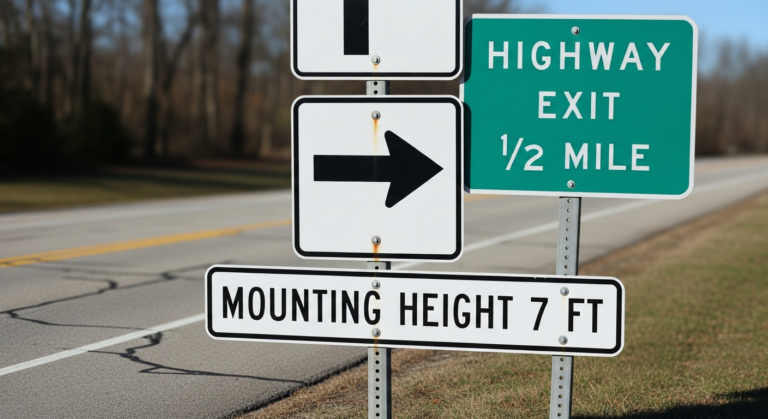
- Urban areas (with curb): Minimum 7 feet from the top of the curb to the bottom of the sign
- Rural areas (no curb): Minimum 5 feet from the road surface to the bottom of the sign
- Overhead signs: Minimum 17 feet clearance for signs mounted over the roadway
When supplemental plaques (such as ALL WAY or 4-WAY plaques) are mounted below the STOP sign, the minimum height is measured to the bottom of the supplemental plaque, not to the bottom of the STOP sign itself.
Lateral Offset and Placement
STOP signs must be placed on the right side of the approach they control. The lateral offset — the distance from the edge of the roadway to the near edge of the sign — follows the standards in Section 2A.17. In urban areas with curbs, the minimum lateral offset is 2 feet from the face of the curb. In rural areas, the minimum is 6 feet from the edge of the traveled way (or 2 feet from the shoulder, whichever is greater). Our lateral offset requirements article covers this topic in full detail.
For multi-lane approaches, a second STOP sign should be placed on the left side of the approach (on a median or on the far-left side) to increase conspicuity. This is particularly important where the approach has two or more lanes in the same direction.
Supplemental Plaques and Enhancements
The MUTCD allows several supplemental plaques and enhancements to be used with STOP signs:
- ALL WAY (R1-3p) plaque: Mounted below the STOP sign at multi-way stop intersections
- Number of approaches plaque: A “4-WAY” or “3-WAY” plaque may be used as an alternative to ALL WAY
- STOP AHEAD (W3-1) warning sign: Placed in advance of the intersection where the STOP sign may not be visible from an adequate distance
- Red flashing beacon: May be used to supplement a STOP sign at locations where additional emphasis is needed
- LED-enhanced border: The 11th Edition allows LEDs around the border of regulatory signs, including STOP signs, for increased conspicuity
Stop Line Pavement Markings
When a stop line is used in conjunction with a STOP sign, the pavement marking standards require it to be a solid white line extending across all approach lanes. The stop line should be placed at least 4 feet in advance of the nearest crosswalk line (where a crosswalk exists) or at the desired stopping point. The standard stop line width is 12 to 24 inches.
Key Takeaways
STOP sign compliance requires attention to multiple interrelated standards — from the engineering study that justifies the sign to ongoing retroreflectivity maintenance. Agencies responsible for STOP sign installations should ensure every aspect meets current MUTCD requirements, particularly as the 11th Edition compliance deadlines approach. Proper sign size, reflective sheeting, mounting height, and lateral placement all contribute to the sign’s effectiveness and the safety of road users.