Complete Guide to Work Zone Traffic Control (MUTCD Part 6)
Work zone traffic control is one of the most critical — and most frequently cited — areas of the MUTCD. Part 6 (Temporary Traffic Control) governs how agencies and contractors must manage traffic through construction, maintenance, and utility work zones. Getting it wrong puts workers and the public at risk and exposes responsible parties to significant legal liability.
This guide covers the key requirements of MUTCD Part 6 that every traffic engineer, road department, and contractor needs to understand.
The Five Parts of a Work Zone
Per Section 6C.04, every temporary traffic control (TTC) zone consists of five distinct areas:
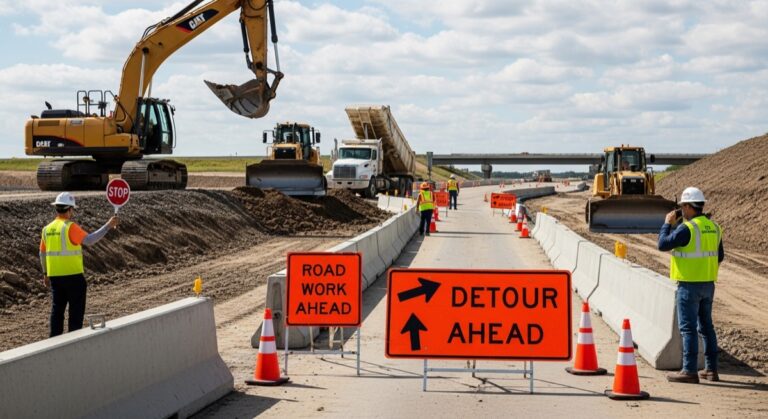
- Advance Warning Area — Alerts approaching drivers that a work zone is ahead. Minimum distances vary by road speed: 500 feet on urban streets (40 mph or less), up to 1/2 mile on freeways.
- Transition Area — Where drivers are channelized from the normal path to the path through the work zone. Taper lengths are calculated using the formula: L = W x S (taper length = lane width x speed) for speeds 40 mph and under, and L = W x S²/60 for speeds above 40 mph.
- Activity Area — The actual work space plus the traffic space where vehicles pass through.
- Buffer Space — A lateral and/or longitudinal area between the traffic space and the work space. No work or storage of equipment is permitted in the buffer space.
- Termination Area — Where traffic returns to the normal path, including a downstream taper and END ROAD WORK sign.
Temporary Traffic Control Plans
Per Section 6C.01, a TTC plan shall be prepared for all work zones on or affecting a roadway. The plan must describe the TTC measures to be used. The MUTCD provides three levels of TTC plan complexity:
- Typical Application (TA) — Standard layouts in Chapter 6H (e.g., TA-1 through TA-38) that can be used directly or adapted for routine operations.
- Project-specific plan — Required for complex projects; prepared by a qualified engineer.
- Blanket or generic plan — Covers routine maintenance operations like pothole patching or mowing.
The Typical Applications in Chapter 6H are the workhorses of work zone traffic control. TA-1 through TA-5 cover two-lane road closures. TA-17 through TA-25 cover multi-lane road scenarios. TA-30 through TA-38 address freeway and expressway operations.
Sign Requirements in Work Zones
All temporary warning signs must use orange backgrounds with black legend per Section 6F.02. Key sign requirements include:
- Minimum sign sizes for work zones are generally one size larger than standard signs on the same road type (Table 6F-1).
- Signs must be mounted on crashworthy supports — sign stands must be breakaway or yielding per NCHRP 350 or MASH requirements.
- Signs shall be removed or covered when not applicable. Leaving work zone signs up when no work is occurring degrades driver compliance.
- Retroreflectivity requirements apply to temporary signs the same as permanent signs.
Channelizing Devices
Per Section 6F.63, channelizing devices include cones, tubular markers, vertical panels, drums, and barricades. Requirements include:
- Traffic cones must be at least 28 inches tall on roads with speeds over 45 mph or at night. Cones used at night must have retroreflective bands.
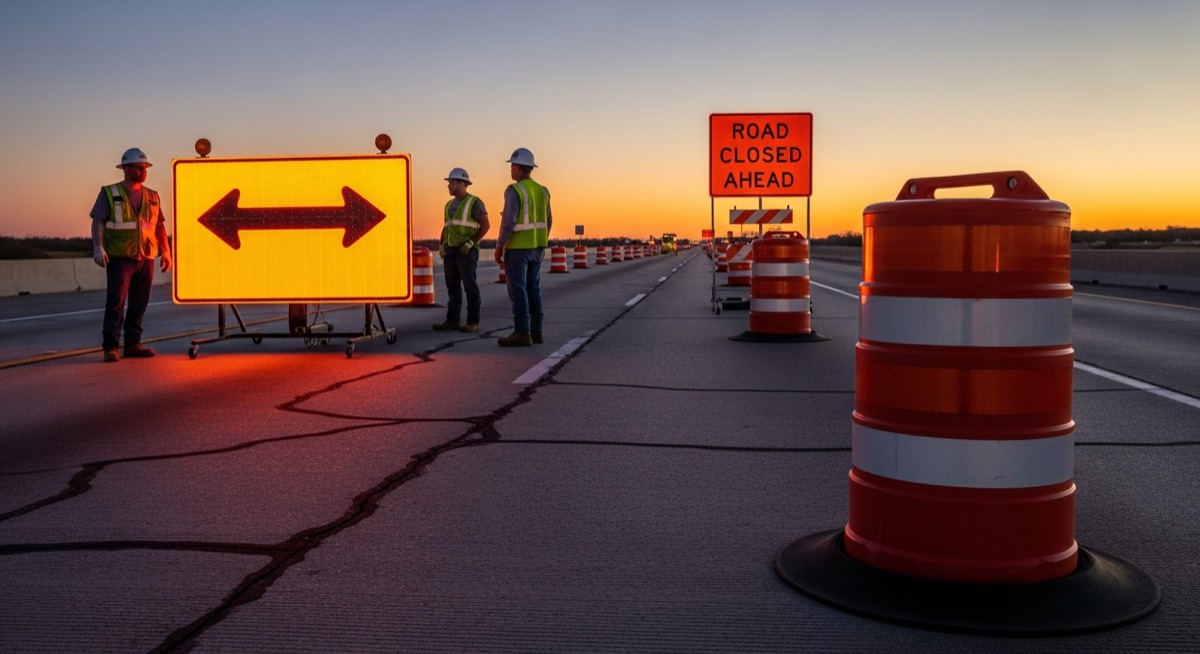
- Drums must be 36 inches high with alternating orange and white retroreflective stripes at least 4 inches wide.
- Spacing for channelizing devices in a taper: maximum of the taper length divided by the number of devices; on tangent sections, devices are typically spaced at 40-foot intervals (low speed) to 120-foot intervals (high speed).
- All channelizing devices must be crashworthy — they cannot be weighted with sand, water bags on top, or other means that would make them hazardous.
Flagging Operations
Section 6E.01 establishes that flaggers are the most expensive form of temporary traffic control and should only be used when other methods are not feasible. When flaggers are used:
- Flaggers shall wear high-visibility safety apparel meeting ANSI/ISEA 107 Class 2 or 3 requirements.
- Flaggers must use a STOP/SLOW paddle (minimum 18 inches) as the primary hand-signaling device (Section 6E.03). Red flags are only permitted in emergencies.
- Flaggers must be trained and positioned at a minimum of 100 feet in advance of the work space (more on high-speed roads).
- An Advance Flagger (W20-7) warning sign shall be placed in the advance warning area.
Speed Reductions in Work Zones
Per Section 6C.01, speed reductions in work zones should be minimized and should not exceed 10 mph below the normal speed limit unless conditions justify it. Regulatory work zone speed limit signs (R2-1 with W20-1 or R2-1 with orange border) require an engineering study or state/local authority. Advisory speed plaques may be used on warning signs without a study.
Common Violations and Pitfalls
- Leaving signs up 24/7 when work only occurs during daytime — this erodes driver trust.
- Undersized signs — work zone signs often need to be larger than standard.
- Missing buffer space — the area between workers and traffic is mandatory, not optional.
- Non-crashworthy devices — sandbags on top of cones, homemade barricades, and similar improvised devices are prohibited.
- No TTC plan on site — a copy of the plan should be available for inspection at all times.
Work zone traffic control is a high-liability area. Following MUTCD Part 6 is not optional — it is the national standard, and deviations must be documented with an engineering study. For complex projects, always involve a qualified traffic engineer in the TTC plan development.