MUTCD Part 7: Traffic Control for School Areas — Complete Reference Guide
Part 7 of the MUTCD addresses traffic control devices specifically for school areas, including school zones, school crossings, and school bus operations. Given the vulnerability of children as road users, Part 7 establishes rigorous standards to protect students walking and biking to school, and to manage traffic in the vicinity of school buildings.
What Part 7 Covers
Part 7 — Traffic Control for School Areas — covers all traffic control devices used in and near schools, from the school speed limit zone signs to adult crossing guard procedures. It integrates signing, marking, signal, and operational standards tailored specifically to the school environment, where road users include young children who may behave unpredictably near traffic.
Key Chapters in Part 7
- Chapter 7A — General: Establishes the scope of school area traffic control, defines school zones and school areas, and outlines the coordination between school officials, law enforcement, and traffic engineering agencies needed for effective school area traffic control.
- Chapter 7B — Signs and Markings in School Areas: Covers school zone speed limit signs (S4-1, S4-3, S5-1), school advance warning signs (S1-1), school crossing signs (S2-1), school zone pavement markings, reduced speed school zone beacons, and end school zone signs. Addresses the use of fluorescent yellow-green for all school-related warning signs.
- Chapter 7C — Crossing Supervision in School Areas: Standards for adult crossing guards (school crossing guards), including training, equipment (STOP paddle, high-visibility apparel), positioning, and procedures for stopping traffic. Also covers student patrol operations.
- Chapter 7D — School Bus Operations: Traffic control related to school bus loading and unloading areas, including bus stop ahead signs and pavement markings.
Critical Standards (SHALL Requirements)
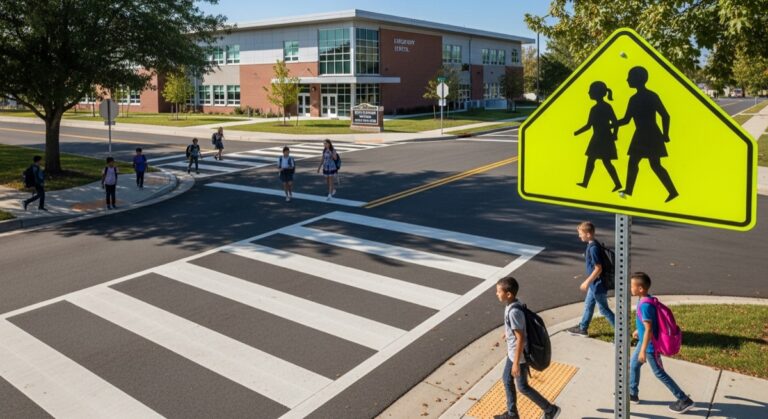
- Section 7B.01 — School Warning Signs: School warning signs SHALL use the fluorescent yellow-green (FYG) background color. The pentagon-shaped School Sign (S1-1) SHALL be used to warn of a school building or school grounds adjacent to the highway.
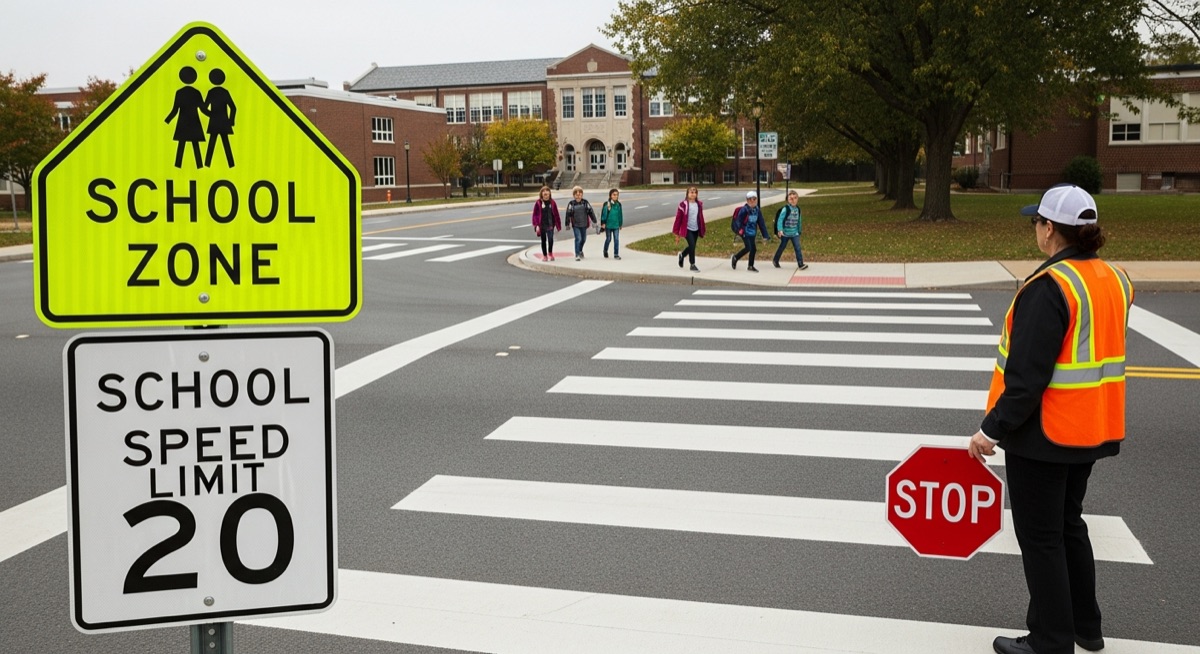
- Section 7B.07 — School Speed Limit Signs: Where a reduced speed limit is established for a school zone, it SHALL be posted with the appropriate speed limit assembly. The School Speed Limit sign (S4-1 or S5-1) SHALL display the regulatory speed limit applicable in the school zone.
- Section 7B.08 — School Zone Limits: The beginning and end of a school zone SHALL be clearly identified with signs. An END SCHOOL ZONE sign or speed limit sign SHALL mark the termination of the school zone.
- Section 7B.09 — School Crossing Signs: A School Crossing assembly (S2-1 with diagonal downward arrow plaque) SHALL be placed at the school crossing location. Advance school crossing signs SHALL be placed in advance of the crossing.
- Section 7B.12 — Pavement Markings: Crosswalk markings at school crossings SHALL be white. High-visibility (continental/ladder) patterns are strongly recommended for school crossings.
- Section 7C.02 — Adult Crossing Guard Equipment: Adult crossing guards SHALL use a STOP paddle conforming to Section 7C.03 as the primary hand-signaling device. Guards SHALL wear high-visibility safety apparel meeting ANSI/ISEA 107 Performance Class 2 or higher.
- Section 7C.03 — STOP Paddle: The adult crossing guard STOP paddle SHALL be octagonal, at least 18 inches (450 mm) in width, and retroreflective. It SHALL display “STOP” in white letters on a red background.
Key Guidance (SHOULD Items)
- School speed limit zones SHOULD be established based on an engineering study that considers the school location, pedestrian volumes, roadway characteristics, and crash history.
- School speed limit zone beacons (flashing beacons on the speed limit sign) SHOULD be used where the school speed limit is in effect only during specific times.
- High-visibility crosswalk markings (continental/ladder pattern) SHOULD be used at all school crossings.
- An engineering study SHOULD be conducted to determine the appropriate location for school crossings, considering routes of student travel and the ability to provide adequate supervision.
- Where traffic signals exist near schools, pedestrian signal timing SHOULD use the reduced walking speed of 3.5 ft/s and SHOULD consider Leading Pedestrian Intervals (LPIs).
School Warning Sign Colors and Shapes
| Sign | Shape | Color | Purpose |
|---|---|---|---|
| School Sign (S1-1) | Pentagon (house shape) | Fluorescent yellow-green | Warning of school building or grounds ahead |
| School Crossing (S2-1) | Pentagon (house shape) | Fluorescent yellow-green | Identifies school crossing location (with arrow plaque) |
| School Speed Limit (S4-1) | Vertical rectangle | Black on white with FYG beacon or border | School zone speed limit |
| School Speed Limit (S5-1) | Vertical rectangle | Black on white with FYG beacon or border | School zone speed limit with time restriction |
| End School Zone (S5-2) | Vertical rectangle | Black on white | Marks end of school speed zone |
Adult Crossing Guard Operations
Part 7 provides detailed procedures for adult crossing guards, who play a critical role in school pedestrian safety:
- Positioning: The guard SHALL stand on the side of the road where students are waiting to cross, not in the roadway, until ready to stop traffic.
- Stopping traffic: When an adequate gap in traffic allows, the guard enters the roadway and displays the STOP paddle toward approaching traffic. The guard SHALL NOT step into the roadway in front of approaching traffic that cannot reasonably be expected to stop.
- Directing pedestrians: Once traffic has stopped, the guard directs students to cross. The guard remains in the roadway until all students have completed their crossing.
- Returning to position: After students have crossed, the guard lowers the STOP paddle and returns to the curb/roadside position.
Compliance Dates
The fluorescent yellow-green background for school warning signs has been a standard requirement since the 2009 Edition. All school warning signs SHALL use FYG. Existing signs not yet converted to FYG should be replaced at the end of their useful life or when the sign is next replaced for any reason. All new school area traffic control installations after January 18, 2024, SHALL comply with the 11th Edition.
What Changed in the 11th Edition
- Reduced pedestrian walking speed: Pedestrian signal timing at school crossings now uses the reduced walking speed of 3.5 ft/s (consistent with Part 4 changes), providing more crossing time for children.
- High-visibility crosswalks strengthened: Stronger guidance for using continental/ladder crosswalk markings at all school crossings, not just uncontrolled crossings.
- Adult crossing guard updates: Clarified training requirements and equipment standards for adult crossing guards, including updated high-visibility apparel requirements.
- School zone beacon provisions: Updated provisions for school zone flashing beacons, including timing and activation requirements.
- Rectangular Rapid Flashing Beacons (RRFBs): RRFBs can now be used at school crossings as a standard treatment (previously an interim approval).
- Coordination with bicycle facilities: New provisions for coordinating school area traffic control with bicycle facilities (referencing Part 9).
Related Resources on mutcd.info
- Part 1: General Provisions — Reference Guide
- Part 2: Signs — Complete Reference Guide
- Part 3: Markings — Complete Reference Guide
- Part 4: Highway Traffic Signals — Reference Guide
- School Zone Signs and Speed Limits
- Crosswalk Marking Standards
For the complete text of Part 7, visit the official FHWA MUTCD at mutcd.fhwa.dot.gov. The Part 7 PDF is available at mutcd.fhwa.dot.gov/pdfs/11th_Edition/part7.pdf.