Railroad Crossing Signs and Markings — MUTCD Part 8 Guide
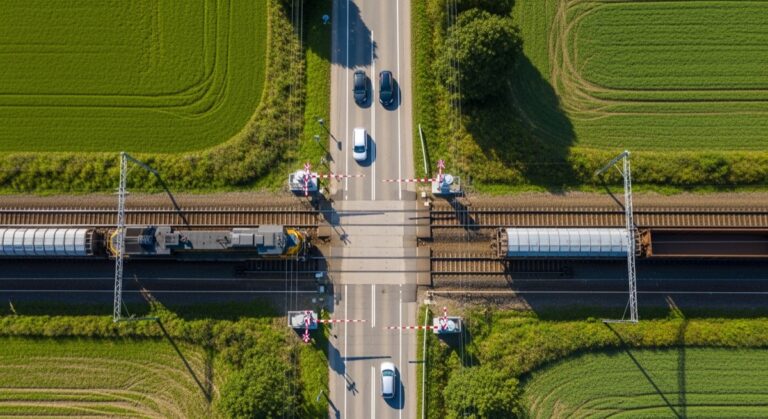
Highway-rail grade crossings are among the most dangerous locations on the road network. MUTCD Part 8 establishes comprehensive standards for signs, signals, markings, and gates that warn drivers and pedestrians of approaching trains. This guide covers the essential traffic control requirements at railroad crossings.
The Crossbuck Sign (R15-1)
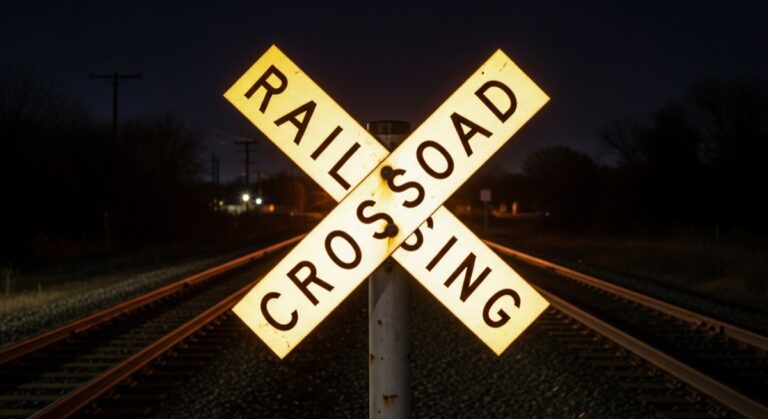
The crossbuck is the most recognizable railroad crossing sign (see also our crossbuck retroreflective strip requirements guide). Per Section 8B.03:
- The crossbuck (R15-1) shall be installed on each approach to every highway-rail grade crossing, at or near the crossing.
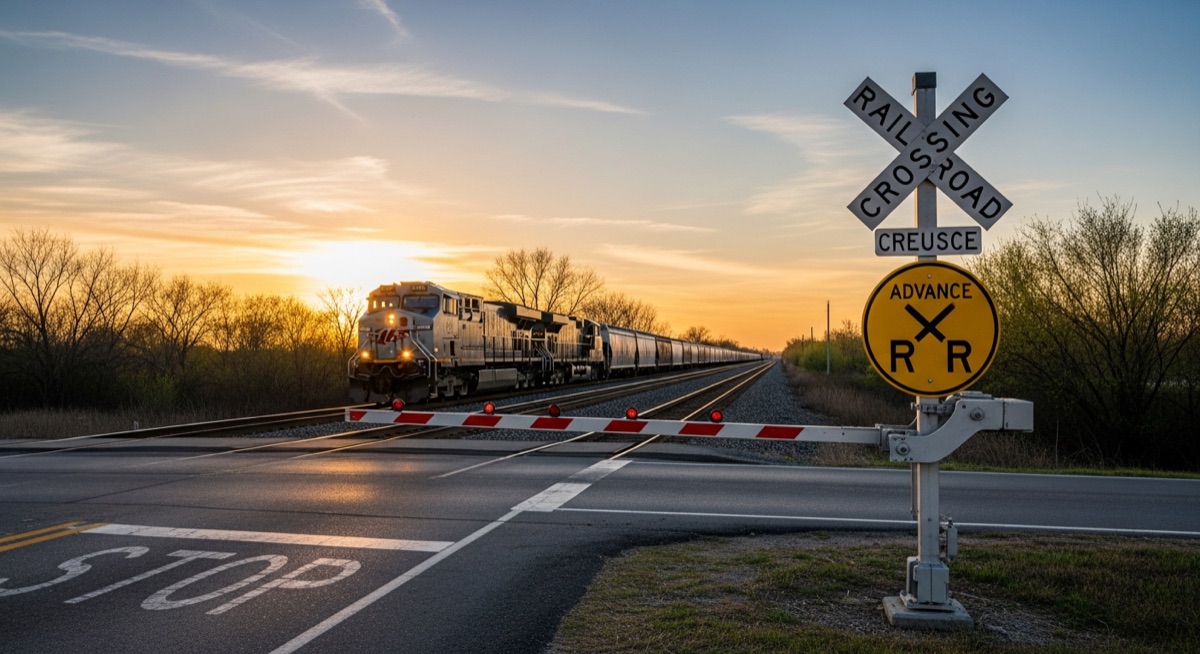
- It is a white, X-shaped sign with the words “RAILROAD CROSSING” in black letters.
- The crossbuck functions as a YIELD sign at passive crossings (those without gates or flashing lights). Drivers must yield to any train occupying the crossing.
- A track count plaque (R15-2P) indicating the number of tracks shall be mounted below the crossbuck at crossings with more than one track.
Advance Warning Signs (W10 Series)
Per Section 8B.05, advance warning signs alert drivers that a railroad crossing is ahead. The W10 series includes:
- W10-1 — Standard advance warning sign (circular, yellow with black “X” and “RR”). This is the only circular warning sign in the MUTCD system, making it unique and instantly identifiable.
- W10-2 — Used where a parallel road turns and crosses tracks (T-intersection with tracks).
- W10-3 — Used at skewed crossings where the road does not cross the tracks at a right angle.
- W10-4 — Used at storage-distance locations where there is an intersection near the crossing and vehicles may queue across the tracks.
The advance warning sign shall be placed at least 100 feet before the nearest rail on urban roads and at distances specified in Table 2C-4 on higher-speed roads (typically 500-750 feet).
Pavement Markings at Railroad Crossings
Per Section 8B.25, pavement markings at railroad crossings include:
- Railroad crossing symbol — a large “RXR” with white pavement marking, placed in advance of the crossing (see our pavement marking standards guide for color and width details). Required on all paved approaches where the posted or statutory speed is 40 mph or greater, and at any crossing with active warning devices.
- Advance stop line — a white transverse line across the approach lanes, placed at least 15 feet from the nearest rail.
- No-passing zone markings — double solid yellow center lines are required in the no-passing zone approaching a crossing on two-lane roads.
- Dynamic envelope markings — white markings showing the area that a train may occupy, used at crossings with skewed alignments or multiple tracks.
Active Warning Devices
Active warning devices are activated by approaching trains. Per Section 8C.01 and subsequent sections:
- Flashing-light signals — alternating red lights mounted on a mast or cantilever. Shall flash at a rate of 35 to 65 times per minute per Section 8C.02.
- Automatic gates — descend across the approaching lanes when a train is detected. Per Section 8C.05, gates shall have alternating red and white retroreflective stripes. When gates are present, flashing-light signals are also required.
- Wayside horns — may be used as a supplement or alternative to train horns in quiet zones per Section 8C.08.
The decision to install active warning devices (versus passive-only crossbucks) is based on factors including train speed, train frequency, highway traffic volume, crash history, and sight distance. The U.S. DOT Diagnostic Team process is used to evaluate crossings.
Retroreflective Strips on Gate Arms
Per Section 8C.05, gate arms shall have retroreflective stripes on both sides. The stripes alternate red and white, are at least 3 inches wide, and slope downward at 45 degrees toward the tip of the gate arm. This pattern ensures the gate arm is visible from both directions at night.
Stop Signs and Yield Signs at Crossings
Per Section 8B.06:
- A YIELD sign (R1-2) or STOP sign (R1-1) may be installed at a passive grade crossing in conjunction with the crossbuck.
- A STOP sign shall not be used at crossings with active warning devices (flashing lights or gates), because the active device controls the stop requirement.
- The decision to install a STOP sign at a passive crossing requires an engineering study considering sight distance, traffic volume, train frequency, and approach speed.
Quiet Zones and Supplemental Safety Measures
Quiet zones — where train horns are not routinely sounded — require supplemental safety measures to compensate for the absence of the audible warning. These may include:
- Wayside horns directed at the roadway approach
- Median barriers to prevent gate-arm circumvention
- Four-quadrant gate systems
- Photo enforcement
All quiet zone installations must be coordinated with the railroad and approved by the FRA (Federal Railroad Administration).
Key Compliance Reminders
- Every crossing must have crossbucks — there are no exceptions.
- Advance warning signs are required on all approaches.
- Pavement markings are mandatory on paved approaches at 40+ mph or where active devices are present.
- Gate arms and flashers must be maintained in working condition — a non-functioning active device is an immediate safety and liability concern.
- All signs and markings must meet retroreflectivity standards.
Railroad crossing safety is a shared responsibility between highway agencies, railroad companies, and the FHWA. Maintaining MUTCD-compliant traffic control devices at every crossing is a critical part of the nationwide effort to reduce grade crossing incidents.