MUTCD Part 8: Traffic Control for Railroad and Light Rail Transit Grade Crossings — Complete Reference Guide
Part 8 of the MUTCD covers traffic control devices at railroad and light rail transit (LRT) grade crossings — intersections where a road crosses railroad tracks at the same elevation. These are among the most safety-critical locations in the transportation network, and Part 8 establishes stringent standards for the signs, signals, markings, gates, and other devices used to warn and protect road users and pedestrians at these crossings.
What Part 8 Covers
Part 8 — Traffic Control for Railroad and Light Rail Transit Grade Crossings — addresses the full range of traffic control devices used at highway-rail and highway-LRT grade crossings. This includes passive devices (signs and markings), active devices (flashing lights and gates), signal preemption, pedestrian provisions, and the coordination between highway traffic signals and railroad warning systems.
Key Chapters in Part 8
- Chapter 8A — General: Establishes the scope of Part 8, defines key terms (grade crossing, active/passive systems, preemption), and outlines the coordination responsibilities between highway agencies, railroad companies, and transit authorities.
- Chapter 8B — Signs and Markings at Grade Crossings: Standards for the crossbuck sign (R15-1), advance warning signs (W10 series), pavement markings (railroad crossing symbols, stop lines), and STOP or YIELD signs at passive crossings. Includes the Do Not Stop on Tracks sign (R8-8) and other supplemental signs.
- Chapter 8C — Active Traffic Control Systems for Grade Crossings: Covers flashing-light signals, automatic gates, audible warning devices (bells), and the activation and deactivation sequences for active warning systems. Includes standards for constant warning time circuits and gate arm positioning.
- Chapter 8D — Highway Traffic Signal Preemption at Grade Crossings: Standards for preemption of highway traffic signals by approaching trains, including the interconnection between railroad warning systems and highway signal controllers, advance preemption timing, and queue clearance requirements.
- Chapter 8E — Pedestrian and Bicycle Grade Crossings: Standards for pedestrian crossings at railroad grade crossings, including pedestrian gates, audible and visual warnings, accessible pedestrian features, and pathway crossings separate from the roadway.
- Chapter 8F — Light Rail Transit Grade Crossings: Specific standards for traffic control at locations where LRT tracks cross roadways, which have unique characteristics compared to conventional railroad crossings (higher frequency, different train speeds, urban settings).
Critical Standards (SHALL Requirements)
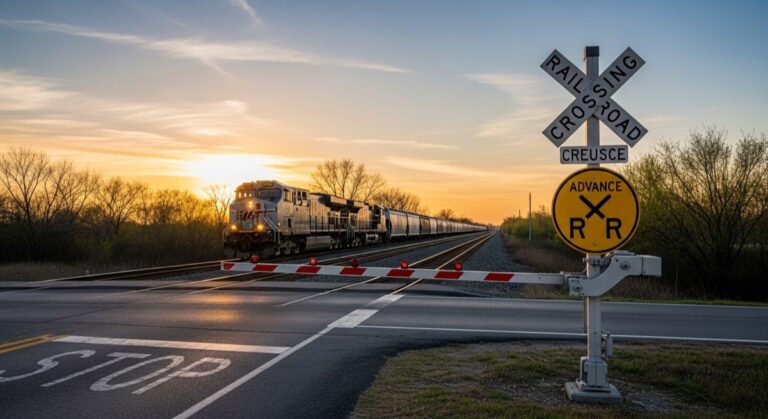
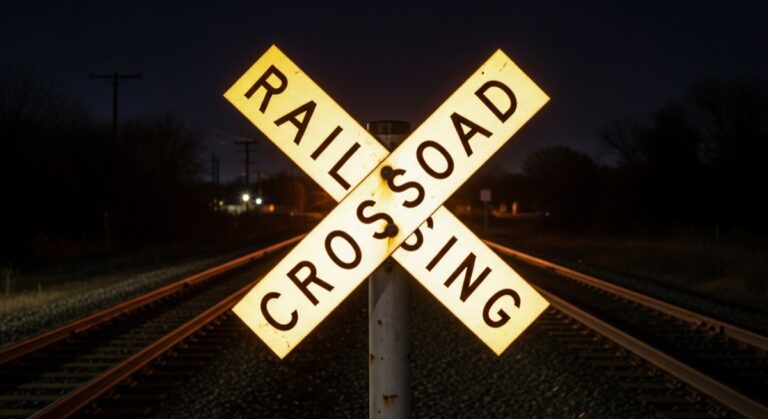
- Section 8B.03 — Crossbuck Sign (R15-1): The Crossbuck sign SHALL be installed at every public highway-rail grade crossing, regardless of whether active warning devices are present. It SHALL be installed on the right-hand side of the approach on each roadway approach to the crossing.
- Section 8B.04 — Advance Warning Sign (W10-1): An Advance Warning sign (W10-1, the round yellow sign with black “X” and “RR”) SHALL be placed on each approach to every public highway-rail grade crossing.
- Section 8B.05 — Pavement Markings: Pavement markings consisting of an “X,” the letters “RR,” and a no-passing marking SHALL be placed on the approach to every public highway-rail grade crossing where the centerline or no-passing marking exists. The specific layout is shown in Figure 8B-2.
- Section 8B.06 — STOP or YIELD Signs: At passive grade crossings (those without active flashing-light signals or gates), a YIELD (R1-2) or STOP (R1-1) sign SHALL be installed at the crossing. The default is YIELD; STOP is used where sight distance is restricted or where an engineering study supports its use.
- Section 8C.01 — Flashing-Light Signals: Flashing-light signals at grade crossings SHALL consist of two red lights flashing alternately. The signals SHALL be activated by an approaching train and SHALL continue to operate until the train has cleared the crossing.
- Section 8C.02 — Automatic Gates: Where automatic gates are used, they SHALL be used in combination with flashing-light signals. The gate arm SHALL be striped with retroreflective red and white diagonal stripes and SHALL descend across the approaching lanes of traffic.
- Section 8D.01 — Preemption Requirements: Where a traffic signal is located within proximity of a railroad grade crossing, the traffic signal SHALL be preempted to clear vehicles from the tracks and prevent vehicles from being directed into the crossing when a train is approaching.
Key Guidance (SHOULD Items)
- Active warning devices (flashing-light signals and gates) SHOULD be installed at grade crossings based on a diagnostic team review or engineering study considering train frequency, speed, traffic volumes, sight distance, and crash history.
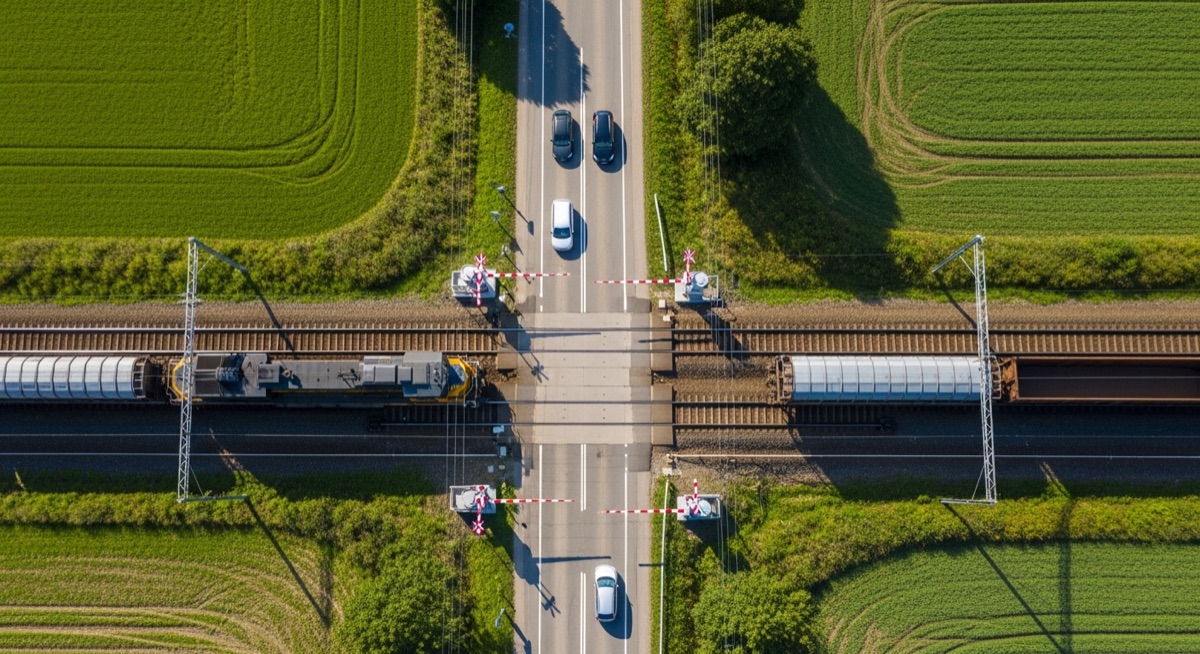
- Four-quadrant gate systems (gates across both approach and departure lanes) SHOULD be considered at locations where drivers frequently drive around lowered gates.
- Advance preemption time SHOULD be sufficient to clear queued vehicles from the track area and provide a minimum track clearance time.
- Wayside horns (directed-sound horn systems) SHOULD be considered as an alternative to locomotive horns at crossings in quiet zones.
- Pedestrian automatic gates SHOULD be installed at grade crossings where significant pedestrian traffic exists and where active warning devices are installed for vehicular traffic.
Types of Grade Crossing Warning Systems
| System Type | Components | Typical Application |
|---|---|---|
| Passive | Crossbuck, advance warning sign, pavement markings, YIELD or STOP sign | Low-volume crossings, low train frequency, good sight distance |
| Flashing Lights Only | Flashing-light signals + all passive devices | Moderate-volume crossings, moderate train frequency |
| Flashing Lights + Gates | Flashing-light signals, automatic gates, bells + all passive devices | Higher-volume crossings, higher train frequency, limited sight distance |
| Four-Quadrant Gates | Gates across all lanes (approach and departure) + flashing lights + bells | High-risk crossings where gate violations are a concern |
| Grade Separation | Overpass or underpass (eliminates at-grade conflict) | High-volume crossings, high-speed rail, highest-risk locations |
Advance Warning Sign (W10 Series)
| Sign | Description | Use |
|---|---|---|
| W10-1 | Round yellow sign with black “X” and “RR” | Advance warning of highway-rail grade crossing |
| W10-2 | Crossroad with railroad crossing (side road) | Advance warning when railroad parallels the highway |
| W10-3 | T-intersection with railroad crossing | Advance warning at T-intersection near crossing |
| W10-5 | Low ground clearance | Warning for vehicles with low ground clearance |
Compliance Dates
All new grade crossing installations or upgrades after January 18, 2024, SHALL comply with the 11th Edition. Existing crossings remain compliant until they are upgraded or conditions change that trigger a review. Railroad-highway grade crossing improvements funded through federal programs (such as the Section 130 program) shall incorporate 11th Edition standards.
What Changed in the 11th Edition
- Pedestrian and bicycle provisions expanded: Chapter 8E provides more detailed standards for pedestrian and bicycle crossings at railroad grade crossings, including accessible features and pathway crossings.
- Light rail transit provisions enhanced: Chapter 8F was updated to address the growing number of LRT systems nationwide, with specific standards for traffic control at LRT crossings in urban and suburban environments.
- Preemption timing clarified: Updated standards and guidance for signal preemption timing, including advance preemption and queue clearance, reflecting best practices from recent research.
- Quiet zone provisions: Updated provisions addressing traffic control device requirements at quiet zones where locomotive horns are not routinely sounded.
- Dynamic envelope markings: New provisions for pavement markings and signs that indicate the dynamic envelope (the area that a train can occupy) at skewed crossings.
- Wrong-way protection: New provisions for preventing wrong-way movements at crossings, particularly at crossings with one-way streets or divided highways.
Related Resources on mutcd.info
- Part 1: General Provisions — Reference Guide
- Part 2: Signs — Complete Reference Guide
- Part 4: Highway Traffic Signals — Reference Guide
- Railroad Crossing Signs and Markings
- Traffic Signal Preemption at Railroad Crossings
For the complete text of Part 8, visit the official FHWA MUTCD at mutcd.fhwa.dot.gov. The Part 8 PDF is available at mutcd.fhwa.dot.gov/pdfs/11th_Edition/part8.pdf.