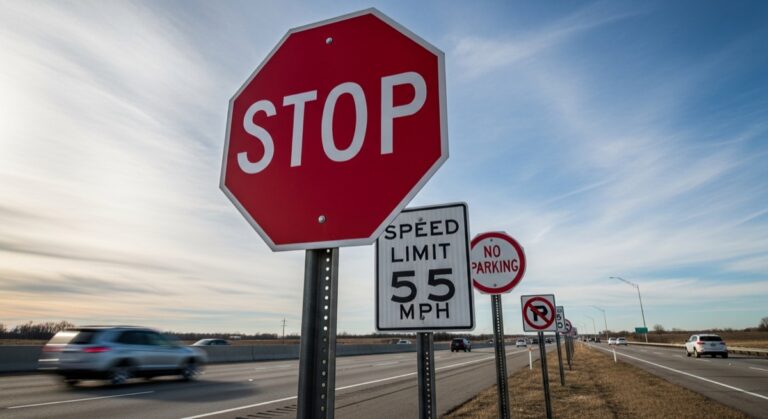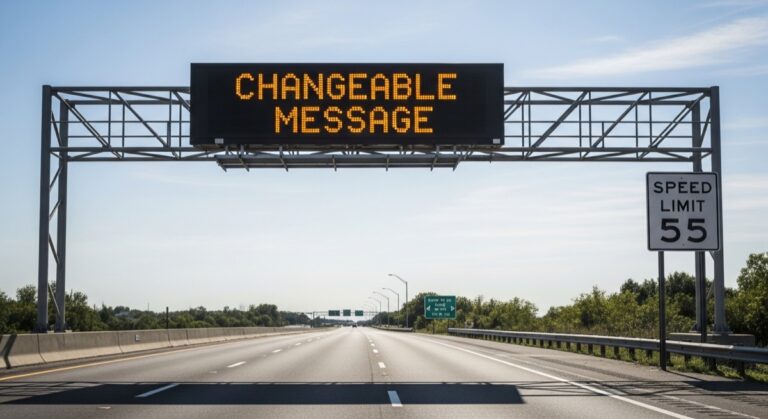
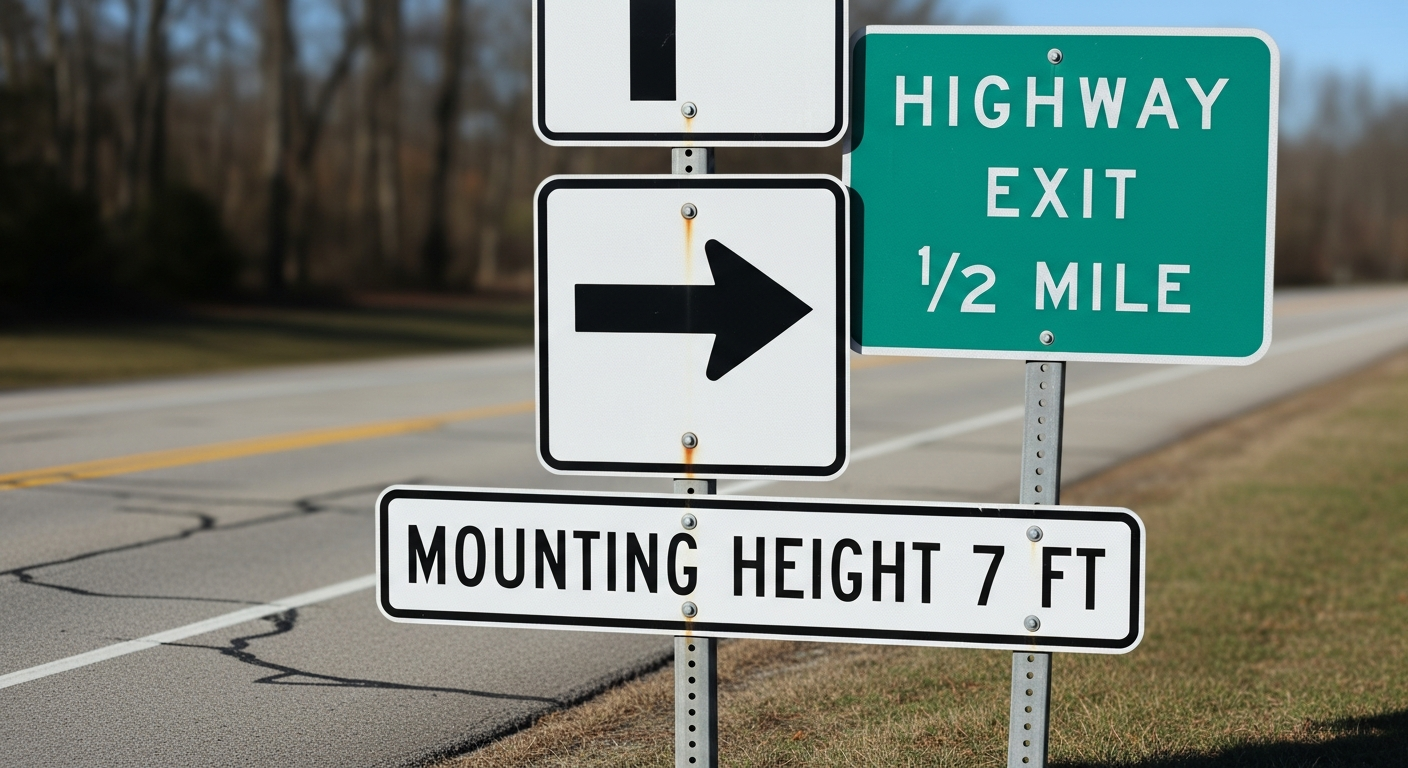
Correct mounting height and lateral offset are fundamental to traffic sign visibility and safety. A sign that is too low can be obscured by parked vehicles, while one placed too far from the road may go unnoticed. The MUTCD establishes clear standards for both vertical and horizontal sign placement to ensure that every sign is visible, legible, and effective. This guide covers the key requirements from Sections 2A.17 and 2A.18 of the MUTCD.
Standard Mounting Heights
MUTCD Section 2A.18 specifies minimum mounting heights for roadside and overhead signs. The mounting height is measured from the bottom of the sign (or the bottom of the lowest supplemental plaque) to the elevation of the near edge of the traveled way. The standards differ based on the installation environment:
Urban Areas (Curbed Roadways)
In urban areas where curbs and sidewalks are present, the minimum mounting height is 7 feet measured from the top of the curb to the bottom of the sign or plaque. This higher clearance protects pedestrians walking beneath signs and prevents parked vehicles from obscuring the sign face. Where signs are mounted above sidewalks or pedestrian paths, the 7-foot clearance is essential for ADA compliance and pedestrian safety.
Rural Areas (No Curb)
In rural areas without curbs, the minimum mounting height is 5 feet from the roadway surface to the bottom of the sign or the lowest supplemental plaque. The lower height is acceptable because there is typically no pedestrian traffic beneath the sign, and the lower position can actually improve headlight retroreflectivity for approaching drivers.
Overhead Sign Installations
Signs mounted on overhead structures spanning the roadway must maintain a minimum vertical clearance of 17 feet to the bottom of the sign. On freeways, some agencies use 17.5 feet or more to provide additional clearance for overheight loads. The mounting height for overhead signs is measured from the road surface directly beneath the sign.
Special Cases
- School zones: Signs in school zones follow the same 7-foot urban and 5-foot rural standards, with assembly-specific requirements in Part 7
- Temporary traffic control: Work zone signs (Part 6) may use a minimum mounting height of 1 foot above the pavement for portable sign supports, as detailed in the work zone traffic control guide
- Parking signs and meters: Parking regulatory signs may be mounted at a lower height where space is limited, but the MUTCD recommends maintaining the standard heights where practical
Lateral Offset Standards
MUTCD Section 2A.17 defines how far a sign must be placed from the edge of the roadway. This distance, known as the lateral offset, serves two purposes: it keeps the sign out of the path of errant vehicles, and it positions the sign within the driver’s cone of vision. Our detailed lateral offset requirements article explores this topic in depth.
Rural Roadways
On rural roads without curbs, the minimum lateral offset from the edge of the shoulder (or from the edge of the traveled way where there is no shoulder) to the near edge of the sign is 6 feet. Where shoulders are present, the measurement is taken from the outside edge of the shoulder. On roads with narrow or no shoulders, the 6-foot minimum from the traveled way edge should be maintained where possible.
Urban Roadways
In urban areas with curbs, the minimum lateral offset is 2 feet from the face of the curb to the near edge of the sign. Where there is a sidewalk, the sign must not reduce the sidewalk width below the minimum required for pedestrian accessibility. A lateral offset of 2 feet from the curb face is the minimum — greater distances are acceptable and often preferable where space allows.
Expressways and Freeways
On expressways and freeways, lateral offsets are typically much greater — often 12 feet or more from the edge of the traveled way. These larger offsets account for higher speeds and provide recovery room for errant vehicles. The specific offset may be governed by the AASHTO Roadside Design Guide in addition to the MUTCD.
Clear Zone Considerations
Sign supports located within the roadside clear zone represent a potential fixed-object hazard. The MUTCD and AASHTO Roadside Design Guide work together to address this risk. The clear zone is the area adjacent to the traveled way where a driver who leaves the roadway should be able to recover safely. Its width varies by speed, traffic volume, and roadside geometry, but typically ranges from 7 to 30 feet or more.
When a sign support must be placed within the clear zone, the MUTCD requires (or strongly recommends) the use of breakaway, yielding, or frangible supports. These supports are designed to give way upon vehicle impact, reducing crash severity.
Breakaway Sign Supports
Section 2A.19 of the MUTCD addresses the structural requirements for sign supports. Key requirements include:
- Sign supports located within the clear zone on roads with speeds above 40 mph shall be of a breakaway or yielding design
- Breakaway supports must be tested and certified per AASHTO or NCHRP 350 / MASH crash-testing standards
- Large roadside signs on multiple supports (such as guide signs) may use slip-base or frangible base systems
- Wood posts of 4×4 inches or smaller are generally considered yielding and acceptable
- U-channel and square tube posts under certain sizes are also accepted as breakaway
Proper sign placement is more than meeting a minimum height and offset — it requires consideration of visibility, safety, and maintainability. Agencies should document their sign installations and review them periodically to ensure continued compliance with the MUTCD 11th Edition compliance dates. For standard sign dimensions, see the regulatory sign sizes guide.